Winning the race to Unified Commerce
DOWNLOAD FREE REPORT
8 minute read
Turn unified commerce investment into measurable value
Research with 100 senior decision-makers reveals why transformation stalls and what the strongest performers do differently
Momentum alone is not enough. Retail transformation is accelerating, but execution remains uneven. Customer journeys now span physical, digital and emerging channels, while disconnected systems, fragmented data and delivery structures limit how quickly organisations can respond and how consistently investment translates into value.
Produced by Retail Economics in partnership with PMC, Winning the race to unified commerce: The hidden economics of enterprise transformation examines where transformation is creating measurable value, how investment is being prioritised and which execution conditions separate stronger performers. Two linked stories emerge: AI adoption is advancing quickly, but the foundations needed to scale it are less consistently embedded, while transformation barriers change as organisations progress.

What you can learn from this report
• Assess whether transformation investment is supported by connected systems, dependable data and clear commercial priorities.
• Understand how barriers shift from legacy technology and fragmented data towards coordination and adoption as transformation advances.
• Identify where execution friction raises costs, delays delivery and weakens the commercial case for change.
• Benchmark the ownership, sequencing and adoption conditions associated with stronger transformation outcomes.
• Apply a practical playbook to define value, fix foundations, sequence delivery, embed adoption and scale proven capabilities.
Key report insights
• 56% report revenue growth from unified commerce activity, alongside improvements in customer experience (53%), margins (44%) and faster decisions (40%).
• 41% rank data integration, analytics or AI readiness as a top-three investment priority, ahead of systems integration and architecture and cybersecurity, resilience or compliance, both at 36%.
• Modernising core systems requires additional investment equivalent to an estimated 5.3% of annual revenue, implying a £25bn modernisation requirement across UK retail.
• 61% report clear transformation objectives, but only 36% measure ROI very effectively, exposing a gap between strategic intent and commercial proof.
• 69% have AI live or scaled, compared with 50% reporting connected foundations fully in place and 44% describing their data foundations as highly ready.
• Transformation barriers increase cost-to-serve for 46% and the cost of change for 45%, while delayed ROI and slower transformation delivery are each cited by 37%.
• The 11% Club combines transformation momentum with execution readiness. Every member is ahead of plan, while nine in 11 report very effective ROI measurement and highly ready data.
1. Investment is creating value, but execution readiness remains uneven
Unified commerce connects a retailer’s channels, customer journeys, systems and data within one operating model. The resulting business-wide view supports more consistent journeys, faster decisions and stronger performance. For many established retailers, years of channel-specific investment have left technology, data and ownership fragmented. Modernising and integrating these foundations is essential to achieving unified commerce.
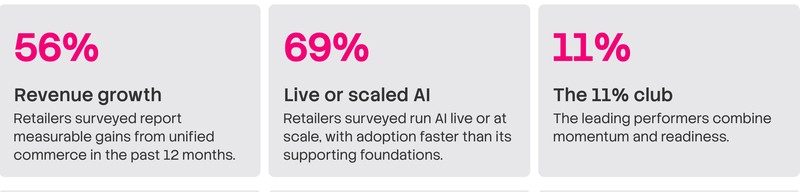
The report’s opening Key Insights graphic captures the opportunity and the execution gap: 56% report revenue growth from unified commerce activity, while 69% have AI live or scaled. A smaller group, the 11% Club, combines momentum and readiness. Their profile provides a benchmark for turning transformation activity into measurable value.
Key Insights
Source: Retail Economics, PMC
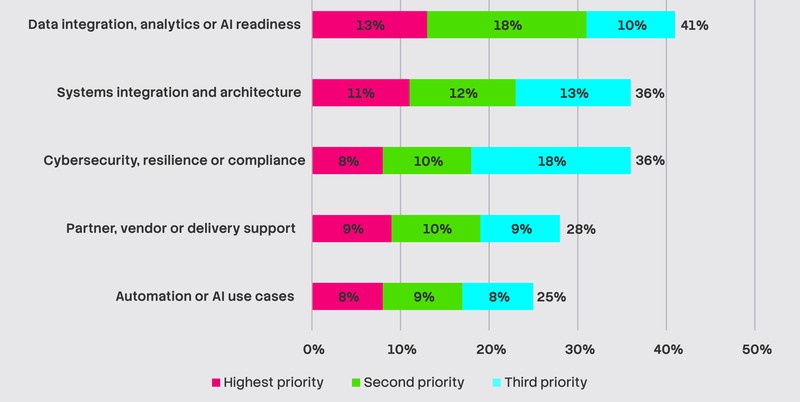
Investment priorities reflect this shift towards more connected operations, particularly on systems and data. Figure 1.3 shows data integration, analytics or AI readiness leading at 41%, followed by systems integration and architecture and cybersecurity, resilience or compliance, both at 36%. Together, these priorities show the focus is on the data, integration, resilience and delivery capabilities needed to support wider transformation, rather than isolated customer-facing improvements.
Figure 1.3 – Highest priorities for transformation investment
Source: Retail Economics, PMC
Implications for retailers: Agree which commercial outcomes transformation must improve and how value will be measured. Prioritise technology debt, poor application fit and data-quality issues according to their commercial impact, linking investment criteria to measurable outcomes and clear ownership.
2. Digital progress exposes the cost of disconnected foundations
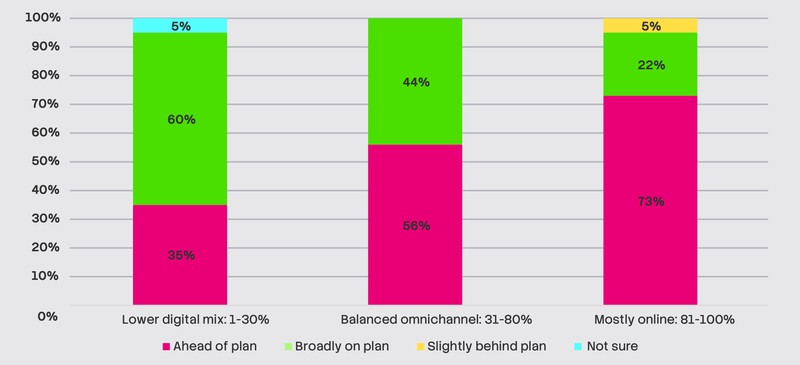
Digital exposure appears to increase the pressure to execute effectively. Figure 1.5 shows that 73% of mostly online organisations are ahead of their intended transformation goals, compared with 56% of balanced omnichannel businesses and 35% of those with a lower digital revenue mix. The comparison highlights uneven delivery across business models, rather than a single pace of transformation across the market.
Figure 1.5 – Delivery against transformation goals strengthens as digital exposure increases
Source: Retail Economics, PMC
Transformation friction is reported most frequently through cost and delivery. Higher cost-to-serve (46%) and a higher cost of change (45%) are the leading consequences, followed by delayed ROI and slower transformation delivery, both at 37%. This weakens the economics of change, raising execution costs and delaying value realisation. The clearest impact sits within the operating model, making cost, delivery speed and time-to-value the strongest commercial case for resolving transformation friction.
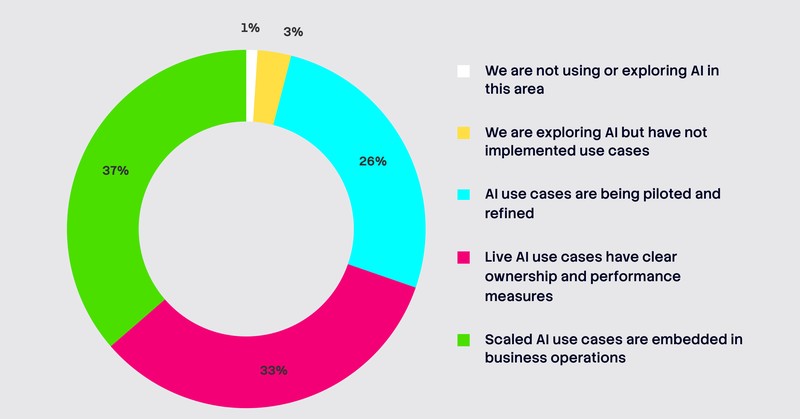
AI readiness is the next test of unified commerce maturity. Figure 1.7 shows that AI use has moved beyond experimentation across much of the market, but the supporting foundations are less consistently established. Half of respondents have connected data, systems and architecture fully in place, while 44% describe their data foundations as highly ready: governed, accessible and integrated. As AI use expands, the challenge shifts towards integrating it with dependable data, systems, governance and delivery capability.
Figure 1.7 – Seven in 10 retailers have moved AI into live or scaled use
Source: Retail Economics, PMC
Implications for retailers: Map the technical, operational and organisational dependencies across the transformation portfolio. Break delivery into manageable releases with clear measures of progress and value. Scaling advanced use cases across uneven foundations risks adding complexity and weakening the value transformation is intended to create.
3. Build the execution environment that turns progress into returns
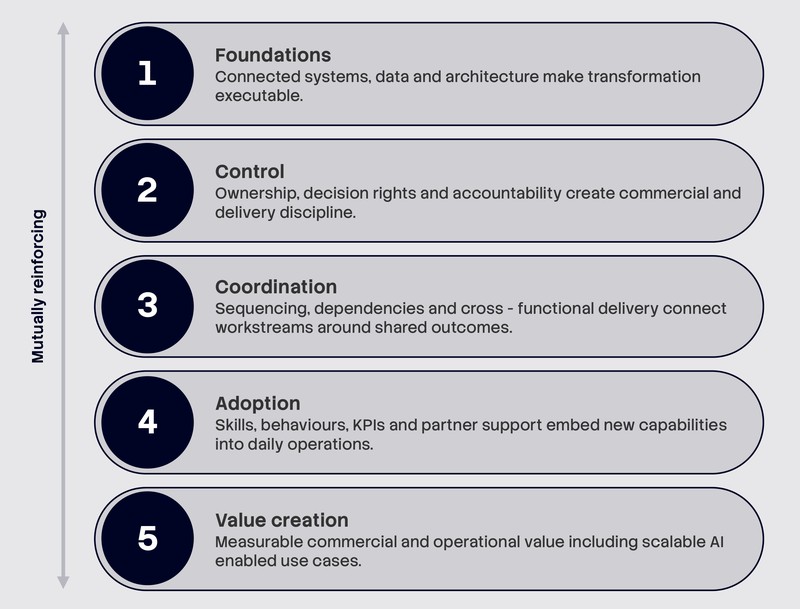
The 11% Club’s position can be understood through the completeness of its execution stack. Stronger performance is associated with connected foundations, control, coordination and adoption being present together, creating the conditions for value creation. Figure 3.1 shows how these layers reinforce one another. They are mutually reinforcing rather than a fixed sequence: weakness in one can limit the ability of the wider operating model to scale transformation and convert activity into measurable value.
Figure 3.1 – The transformation execution stack
Source: Retail Economics, PMC
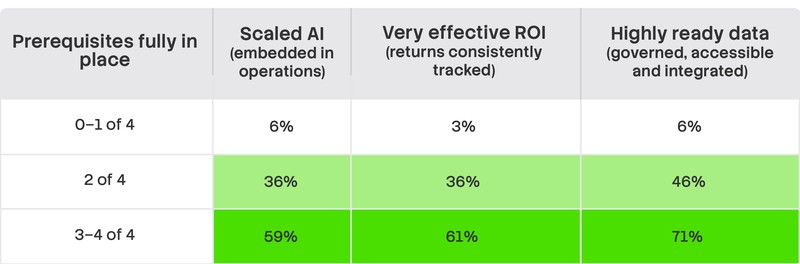
The relationship extends beyond the 11% Club. Across the full sample, scaled AI, effective ROI measurement and highly ready data become substantially more common as more execution prerequisites are fully established. These prerequisites comprise connected foundations, shared ownership and control, delivery sequencing and organisational adoption.
Table 3.3 shows that 59% of organisations with three or four prerequisites fully in place have scaled AI, compared with 6% of those with one or none. Very effective ROI measurement rises from 3% to 61%, while highly ready data rises from 6% to 71%. Stronger outcomes are associated with the breadth of the execution environment, rather than any single capability.
Table 3.3 – Advanced capabilities and outcomes strengthen as execution prerequisites accumulate
Source: Retail Economics, PMC
The strategic playbook translates these findings into five practical moves: define value and commercial priorities, fix the foundations, sequence delivery with a clear plan, embed organisational adoption and scale towards unified commerce. Each stage addresses a different source of transformation friction, from weak commercial definition and disconnected foundations to delivery risk and organisational adoption. Aligning skills, incentives and KPIs with the intended operating model helps turn implementation into sustained organisational change.
Implications for retailers: Establish clear decision rights and accountable owners across functions. Measure adoption, behavioural change and realised value alongside technical delivery. Scale proven use cases through common governance and reusable capabilities, tracking improvements in customer consistency, decision speed and operational performance.
Organisations are already generating value from transformation, but progress remains uneven. The strongest performers combine investment in data, systems and AI with clear commercial priorities, shared ownership and disciplined delivery. The priority now is to strengthen foundations, sequence change around commercial value and embed adoption across the business, creating a connected execution environment that can translate transformation into sustainable returns.