Retail workforce reimagined: The transformative power of AI
DOWNLOAD FREE REPORT
8 minute read
The workforce imperative: how AI is reshaping retail jobs, productivity and performance
We surveyed 250 retail leaders across the UK, France, Germany, United Arab Emirates and the US to understand how AI is transforming roles, skills and operating models across the sector.
This report explores how AI is reshaping retail jobs across stores, head offices and supply chains. Drawing on original research with senior retail leaders, it examines where tasks are already being augmented or automated, where human judgement remains critical, and how the balance between people and technology is likely to evolve over the next decade.
Crucially, it highlights the strategic choices retailers must make today to unlock productivity gains while maintaining trust, engagement and capability across their workforce.
What you can learn from this report
•How leading retailers are using AI to rebalance workloads, reduce low-value tasks and free up employees to focus on higher-impact activity.
•Where AI adoption is delivering the greatest productivity returns today, and which parts of the retail workforce remain most dependent on human judgement and customer-facing skills.
•How to identify tasks that should be automated, augmented or retained as human-led to protect service quality, governance and brand trust.
•What the rise of AI means for skills, training and workforce planning over the next five to ten years, including how retailers are building AI-ready capabilities.
•How retailers can deploy AI responsibly, ensuring productivity gains do not come at the expense of employee engagement, culture or organisational resilience.
10 key insights
• AI tool advancement is the leading global driver of adoption, cited by nearly half (48%) of retailers surveyed.
• Operational efficiency is a major catalyst, with the UK particularly exposed: 48% cite cost pressure as a key motivator for automation.
• Two in five retailers (40%) cite data-driven decision-making as a driver of AI adoption, rising to 50% in the UK.
• Store operations remains the biggest workforce area in retail (51% of employment), shaping where AI-driven productivity gains can scale fastest.
• AI task integration rises across every function by 2035, but at different speeds: leadership reaches 37% (central scenario), while digital & technology operations reaches 73%.
• Support functions (finance, HR, compliance and reporting) show among the highest AI integration potential, rising from 53% (2025) to 68% (2035) in the central scenario.
• Retailers are already backing the shift with investment: on average, they allocate 30% of budgets to digital transformation and innovation aligned to AI.
• Three-quarters (74.4% net balance) of retailers surveyed are investing in upskilling employees to work effectively alongside AI technologies.
• Three-quarters (74.8% net balance) believe AI is improving the day-to-day job satisfaction of retail employees.
• Countries with higher adoption levels show stronger agreement that AI enables more meaningful work—led by the UK (94%) and US (86%), versus 42% in the UAE.
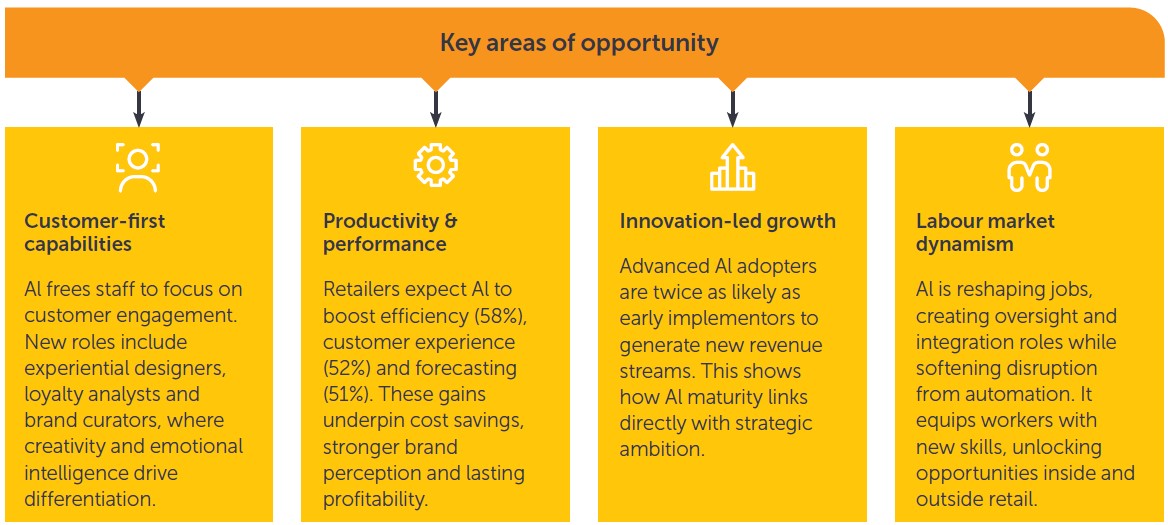
Sneak peek at report insights...
Figure 1 – The timeline to agentic retail
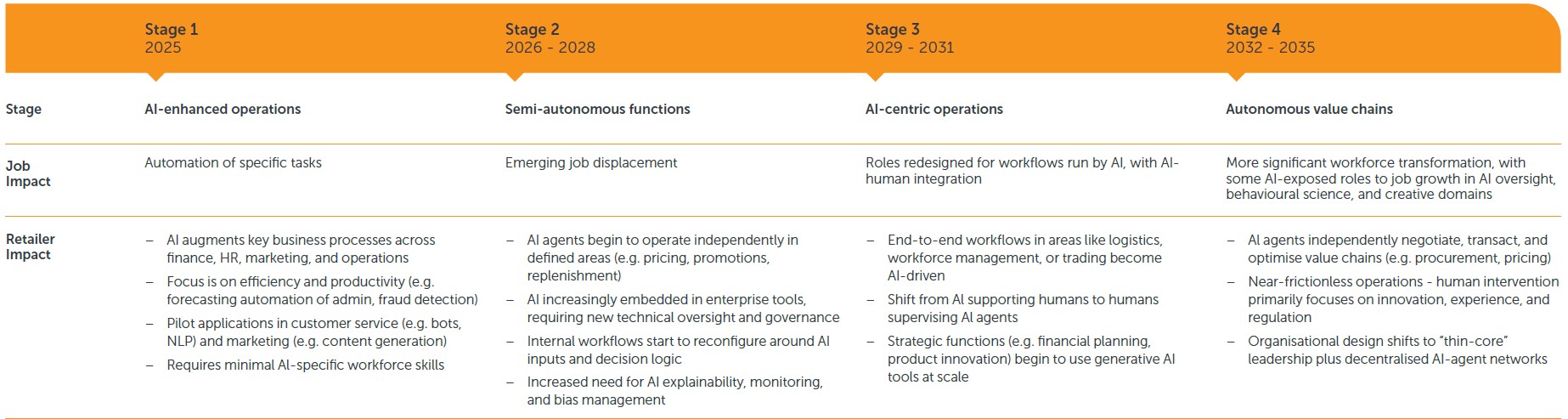
Source: Retail Economics, Eversheds Sutherland
Figure 2 – Drivers of AI adoption and survey insights
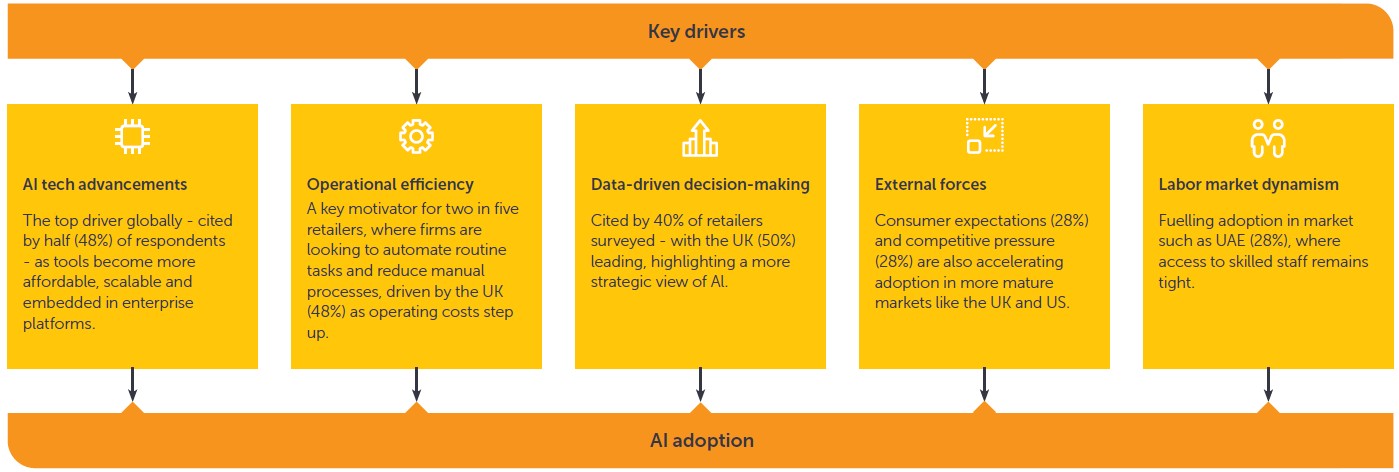
Source: Retail Economics, Eversheds Sutherland
Figure 6 – The ability to integrate AI into jobs over the next decade varies by retail function (Composite AI Task Capability-Integration Score %)
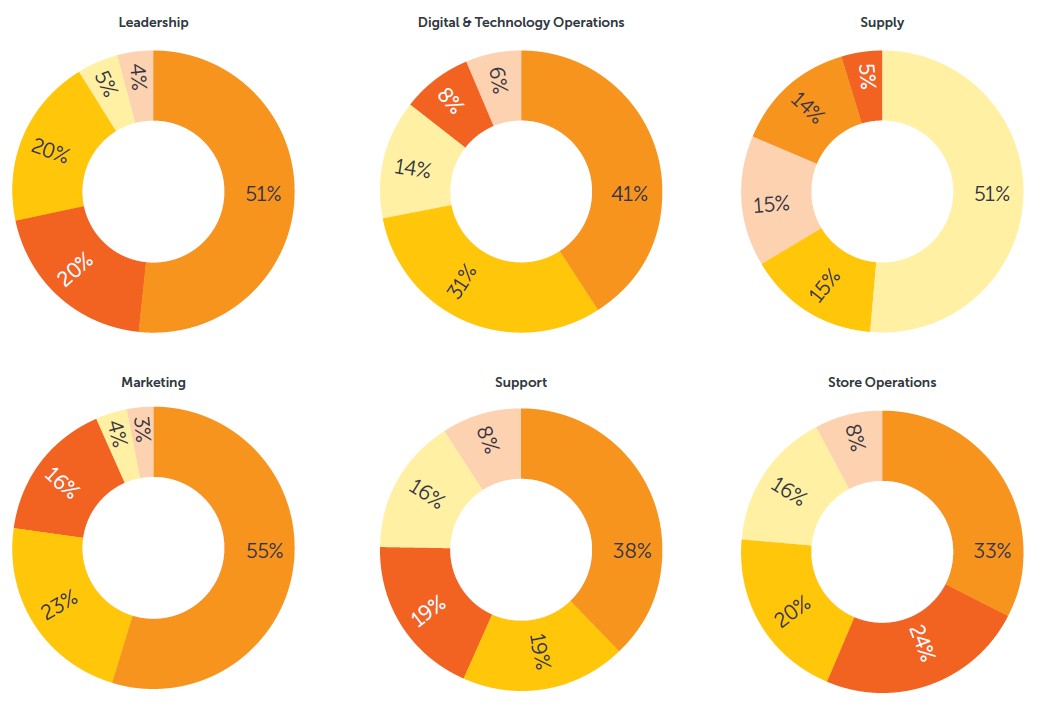
Source: Retail Economics, Eversheds Sutherland