Ecommerce Delivery Benchmark Report 2026
DOWNLOAD FREE REPORT
9 minute read
Excelling at ecommerce in an AI era: how retailers are competing on speed, choice and reliability
We benchmarked leading UK retailers to understand how ecommerce delivery performance is evolving in 2026
Delivery has moved from a functional fulfilment activity to a frontline brand experience. In an environment where customer acquisition costs are rising and loyalty is fragile, delivery performance is now a strategic differentiator. This benchmark report evaluates how leading retailers are performing across speed, flexibility, cost transparency and returns execution — identifying where competitive advantage is being built and where performance gaps remain.
What you can learn from this report
• How your delivery proposition compares against leading UK retailers across speed, cost and service flexibility
• Where delivery choice architecture is strengthening customer trust and repeat purchase behaviour
• How pricing transparency and threshold strategies are shaping perceived value
• What best-in-class returns journeys look like in a cost-pressured ecommerce market
• Strategic actions retailers can take to close performance gaps and build delivery-led loyalty

Key report insights
• The research draws on insights from 8,000+ consumers across eight major ecommerce markets and 400 senior decision-makers, providing one of the most comprehensive views of AI-assisted commerce and delivery readiness in 2026.
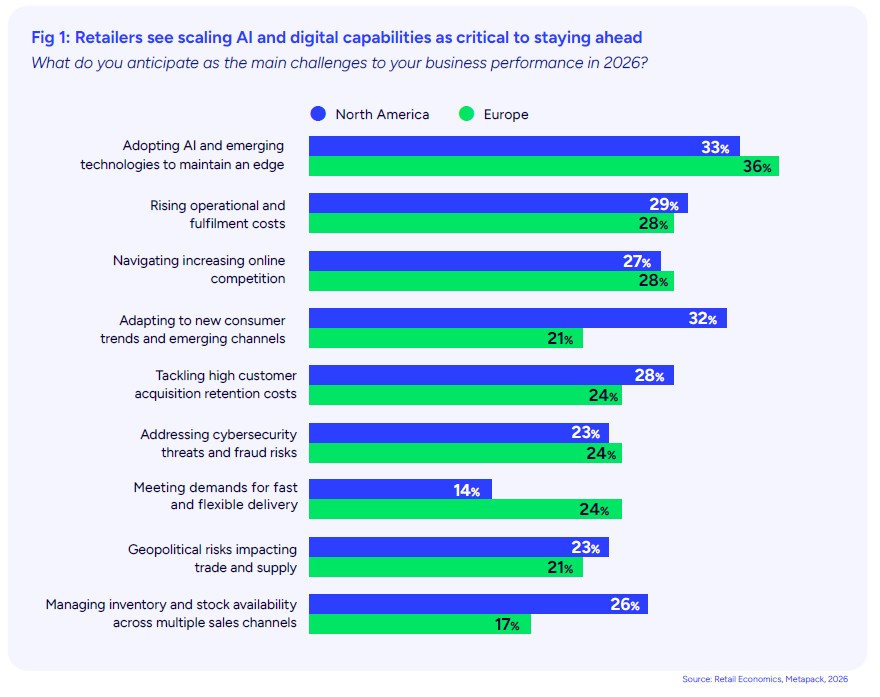
• 33% of North American retailers and 36% of European retailers identify adopting AI and emerging technologies as their main performance challenge in 2026, signalling the scale of operational transformation underway (Fig 1).
• Despite the AI focus, 14% of North American retailers and 24% of European retailers still cite meeting demands for fast and flexible delivery as a key business challenge, reinforcing delivery’s role as a competitive pressure point (Fig 1).
• Retailers are navigating a dual mandate: integrating AI into discovery and conversion while simultaneously strengthening fulfilment networks to support higher customer expectations around speed, choice and reliability.
• The convergence of AI-led shopping journeys and delivery performance means fulfilment is no longer a back-end function but a visible part of the competitive experience layer.
• Regional variation in delivery pressure suggests European retailers are currently feeling more acute strain around fast and flexible fulfilment expectations compared with North America.
• AI readiness and delivery resilience are emerging as parallel strategic imperatives, requiring coordinated investment across technology, operations and customer experience.
Together, these benchmarks demonstrate that delivery excellence is no longer about absolute speed alone. It is about consistency, transparency, optionality and operational resilience. Retailers that treat delivery as a strategic growth lever — rather than a transactional necessity — will be better positioned to convert traffic, strengthen loyalty and protect margin in an increasingly competitive ecommerce landscape.

Sneak peek at report insights...
Ecommerce in 2026: Smarter Competition in the Age of AI
Ecommerce in 2026 is at a moment of rapid convergence. Growth remains the objective, but the conditions under which it’s achieved are shifting fast. Competition is intensifying, consumer expectations are higher than ever, and the way demand is created, influenced, and fulfilled is becoming more complex. Retailers are not responding to a single structural change, but to multiple forces interacting at pace. When retailers were asked which factors are most likely to impact business performance in 2026, adopting AI and new technologies came out on top (Fig 1).
This reflects both the rapid advancement of AI capabilities and the significant scale of change that retailers are navigating. Most retailers recognise the opportunity AI presents. However, they also recognise the pace and complexity involved for successful implementation. Integrating new capabilities into existing platforms, getting data-ready, and managing cultural change requires focus and investment.
Figure 1 – Retailers see scaling AI and digital capabilities as critical to staying ahead
Source: Retail Economics, Metapack, 2026
The rise of Generative AI
Over the past 12 months, generative AI has progressed rapidly from experimentation to everyday use. Tools such as ChatGPT, Google Gemini, and AI-enabled search engines now influence how consumers research, plan tasks, and make decisions. This shift has been relatively seamless due to the ease of using AI, which doesn’t require technical skill. In fact, AI assistants are increasingly used by default, having been integrated into existing platforms (Fig 2).
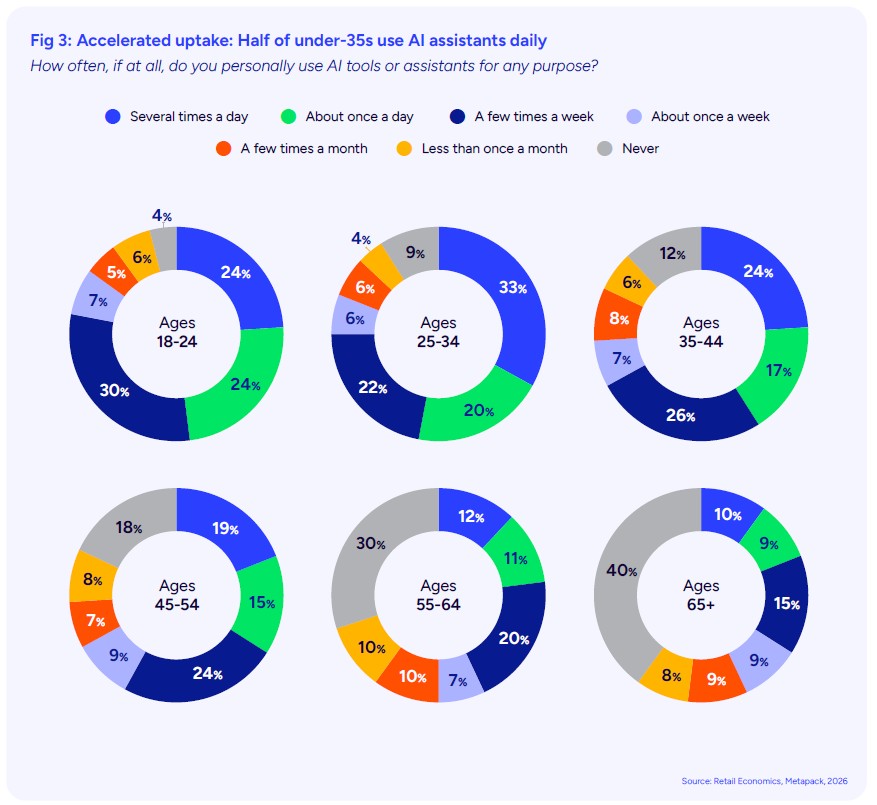
Furthermore, consumers are turning to conversational tools, voice assistants, and early agentic systems that interpret intent and narrow choices on their behalf. Nearly 80% of consumers have utilised a generative AI assistant in the past year, with adoption rates rising to near-universal among those under the age of 35. Even among older age groups, 59% report having tried AI tools, underscoring the rapid pace of mainstream adoption (Fig 3).
Figure 3 – Accelerated uptake: Half of under-35s use AI assistants daily
Source: Retail Economics, Metapack, 2026

Outlook for 2026: Growth ambitions meet rising delivery expectations
Delivery cost has become a prominent driver of choice
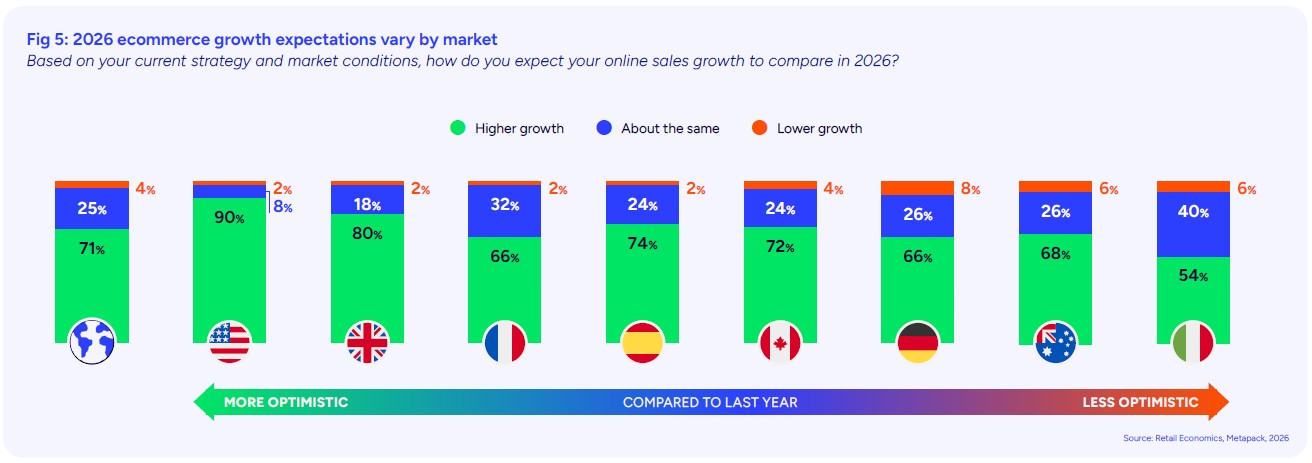
In 2026, retailers remain broadly optimistic about ecommerce growth, but operate in a market where execution matters more than ever. Seven in ten retailers expect online sales growth to strengthen over the next year, with the highest confidence in the U.S., U.K., Spain, and Canada (Fig 5).
Since 2023, delivery cost has become a more prominent driver of choice, reflecting a value-conscious shopper mindset in an environment of easy comparison and abundant choice.Crucially, greater price sensitivity has not translated into lower service expectations.
Figure 5 – 2026 ecommerce growth expectations vary by market
Source: Retail Economics, Metapack, 2026
Fast delivery is now a baseline expectation
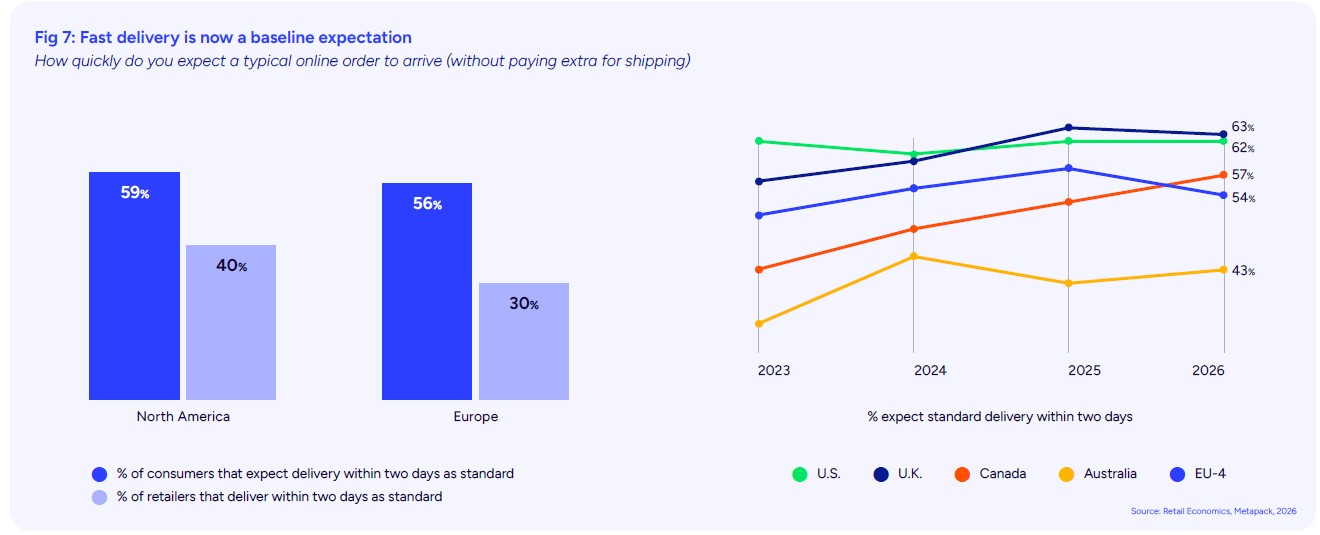
Delivery speed is now widely regarded as a baseline requirement, rather than a differentiator. In North America and Europe, over half of consumers expect a standard online order to arrive within two days. This expectation has remained elevated, even in markets where cost-of-living pressures persist.
However, delivery capability has not kept pace evenly. A clear gap remains between consumer expectations and current provision, most notably in Europe, where fewer retailers offer two-day delivery as standard (Fig 7).
Consumers expect delivery to be fast, flexible, and lowcost, even as retailers contend with elevated fulfilment costs and last-mile complexity.
In 2026 and beyond, AI will play a central role in helping retailers balance these demands more effectively, enabling better decision-making across delivery and fulfilment. As a result, delivery performance is becoming more influential, shaping how both consumers and algorithms identify which retailers are best placed to meet their needs.
Figure 7 – Fast delivery is now a baseline expectation
Source: Retail Economics, Metapack, 2026
The emergence of AI-mediated shopping journeys
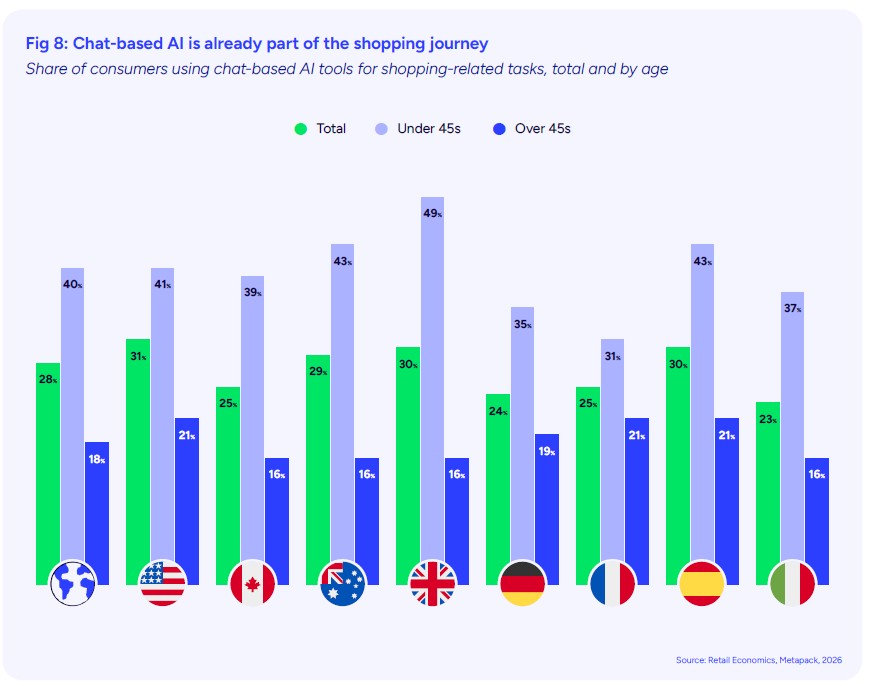
More than a quarter (28%) consumers have used chat-based AI tools for shopping-related tasks within the past 12 months, rising to 40% among those under 45 (Fig 8). In the U.S., over 82 million consumers have used chat-based AI tools such as ChatGPT as part of their online shopping.
Consumers are intentionally using AI with defined objectives. For example, shoppers are using AI for pre-purchase retail tasks, including checking product availability and understanding delivery and return options. Traditionally, this would be conducted via retailer websites, comparison sites, and search engines. Now with AI, it’s in a single, conversational environment.
Figure 8 – Chat-based AI is already part of the shopping journey
Source: Retail Economics, Metapack, 2026
📩 Want to explore the findings or discuss how your business compares? Contact us at info@retaileconomics.co.uk