;
COVID-19 SERVICE: We are heightening our efforts to assist the UK retail & leisure industry through this challenging period. Explore this service now… COVID-19 SERVICE

The Availability Effect: Why trust, margin and loyalty start at the shelf edge


10 minute read

Ensuring availability on the shelf: How grocery retailers protect trust, loyalty and £2.1bn of at-risk sales

We conducted in-store audits across 100+ UK locations and surveyed 2,000 households to quantify how stock gaps shape trust and switching

Availability is a hidden battleground of grocery retail. While price and quality dominate headlines, what ultimately defines shopper trust is reliability. This means consumers finding what they came for, every time. The UK grocery industry is widely regarded as one of the most sophisticated and operationally disciplined in the world, yet even in such a finely tuned system, small inconsistencies can have a disproportionate negative impact.

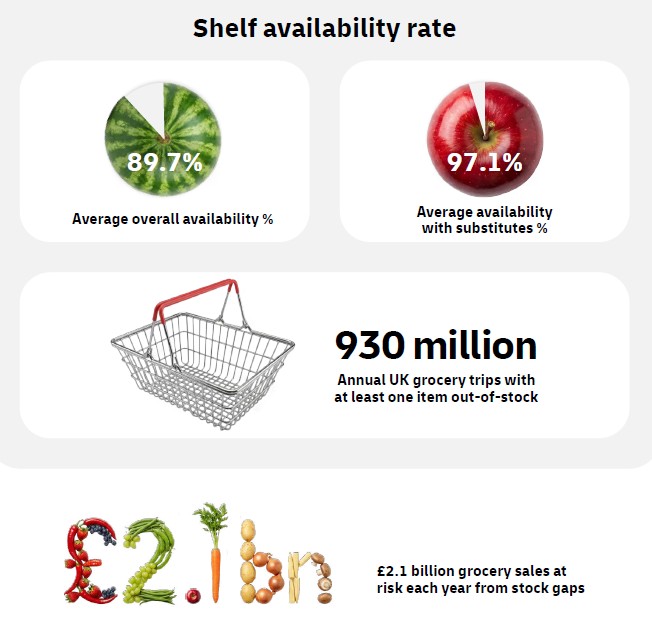
Our national audit found an average on-shelf availability rate of 89.7%, rising to 97.1% when comparable substitutes were included. This consistency reflects a sector that has mastered operational complexity at scale. Yet even within this high-performing system, small differences in availability translate directly into commercial impact.

Drawing on store audit results and consumer tolerance modelling, our study shows £2.1 billion of grocery sales each year are at risk from stock gaps – sales either lost outright or displaced to competitors as shoppers switch stores, delay purchases or trade down.

That risk is far from theoretical. Around one in five grocery trips involves an out-of-stock item – equivalent to roughly 930 million shopping visits each year where shoppers can’t find something they want. While these experiences are often brief, psychologically, they can leave a lasting impression, reinforcing how even small inconsistencies can shape perceptions of reliability.


What you can learn from this report

• Where availability is most likely to break down, across retailer, store format, product category, region and day of week.

• How shopper tolerance shifts from acceptable gaps to frustration and switching, and what the ‘point of no return’ looks like in practice.

• Why mission context matters, and why ‘meal-for-tonight’ and ‘special occasion’ shops carry disproportionate loyalty risk.

• Which shopper personas concentrate the biggest commercial exposure, and how low tolerance shoppers drive most displaced spend.

• The strategic focus points retailers can use to make availability predictable, flexible and resilient end-to-end.


Shelf availability rate
Shelf-availability-rate-food-grocery-dhl-retail-economics.jpg


Average overall availability 89.7%. Average availability with substitutes 97.1%. Annual UK grocery trips with at least one item out-of-stock 930 million. £2.1 billion grocery sales at risk each year from stock gaps.

Source: Retail Economics, DHL Supply Chain


Key insights

• Our national audit found an average on-shelf availability rate of 89.7%, rising to 97.1% when comparable substitutes were included.

• £2.1 billion of grocery sales each year are at risk from stock gaps – sales either lost outright or displaced to competitors as shoppers switch stores, delay purchases or trade down.

• Around one in five grocery trips involves an out-of-stock item – equivalent to roughly 930 million shopping visits each year where shoppers can’t find something they want.

• Across all audits, 82% of stores had at least one item missing from a typical weekly shop, and nearly two-thirds (64%) recorded two or more missing items.

• ‘Meal-for-tonight’ and ‘special-occasion’ shops are the most sensitive missions, with around three in five shoppers saying a missing item would disrupt their shop and often lead to a secondary trip.

• Low-tolerance shoppers (the Defectors and Flexers) account for six in ten consumers, but drive around three-quarters of all sales at risk from stock gaps.

>> Download the full report for the full audit detail, persona segmentation and strategic focus points...


Introduction

How we measured stockouts

Retail Economics conducted in-store audits across 100+ store locations nationwide, across a mix of retailers, formats and regions. Each audit assessed 40 high-frequency grocery items across fresh, ambient and household categories to reflect a typical weekly household shop.

Availability across UK grocery remains high but uneven. The research exposes clear variation by retailer, format, region and day of the week – showing where operational pressures collide with rising shopper expectations for immediacy. Shelf-edge precision now hinges as much on timing, format and product mix, as on supply-chain efficiency. Consistency across stores and throughout the week has become a defining measure of retail execution excellence.


Section 1: Lessons from the shelf edge

Availability snapshot


Availability by retailer

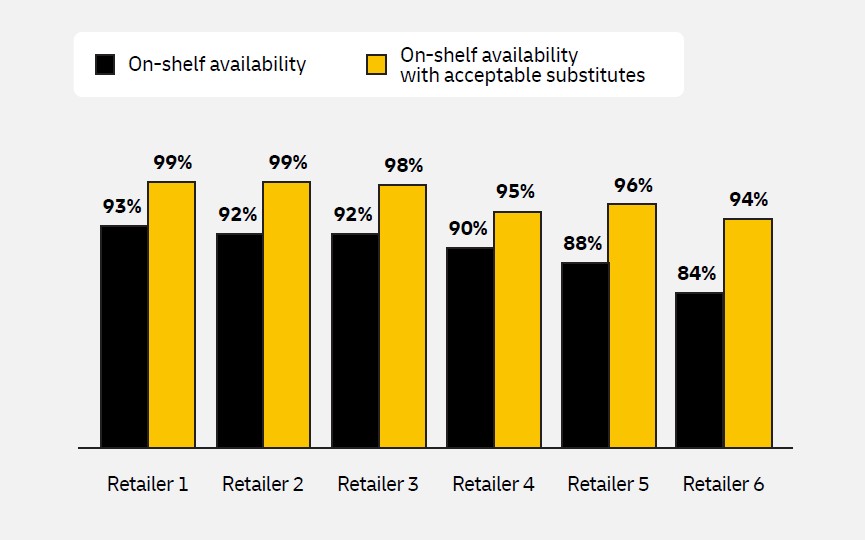
On-shelf availability varies across retailers, reflecting differences in format mix and supply chain execution.
Source: Retail Economics, DHL Supply Chain


On-shelf availability varies across retailers, reflecting differences in format mix and supply chain execution.

Retailer 1 leads at around 93%, with Retailer 2 and 3 close behind, while Retailer 6’s lower score reflects the complexity of smaller convenience formats. Including acceptable substitutes, most achieve above 95% effective availability overall.


Availability by product category
 

Source: Retail Economics, DHL Supply Chain


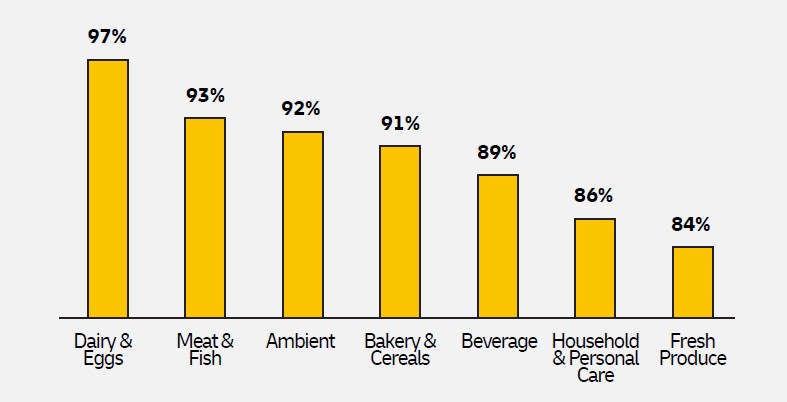
Availability varies by category due to differences in shelf life, handling, and in-store range. Fresh produce is most exposed to short-term gaps driven by tight replenishment cycles, short product life, and limited buffers in smaller stores.

Household and personal care items also sit lower, as slower turnover and bulkier packs lead retailers to carry leaner volumes with less room for disruption. In contrast, ambient groceries and staples benefit from stable demand and optimised restocking, supporting strong on-shelf availability.

Household and personal care items also sit lower, as slower turnover and bulkier packs lead retailers to carry leaner volumes with less room for disruption. In contrast, ambient groceries and staples benefit from stable demand and optimised restocking, supporting strong on-shelf availability.


Availability by store format
 

Source: Retail Economics, DHL Supply Chain


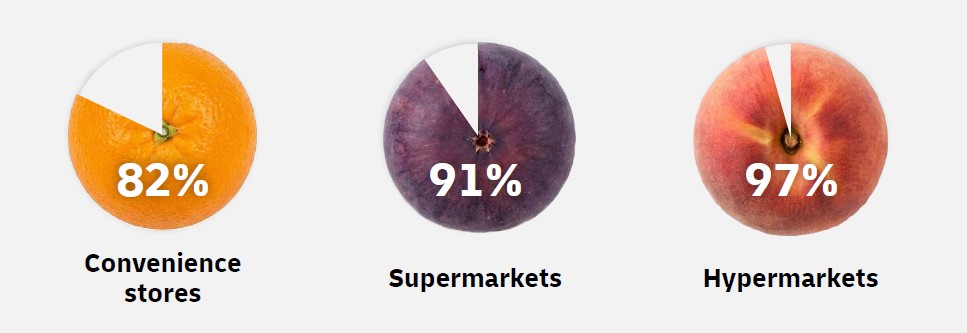
Availability improves with store size, driven by differences in storage, delivery frequency, and operational support. Supermarkets and hypermarkets benefit from larger backrooms, advanced replenishment tools, and dedicated teams, allowing faster response to gaps.

Convenience formats have smaller ranges, limited storage, and centralised ordering, so even minor delays or demand shifts can quickly translate to shelf gaps.


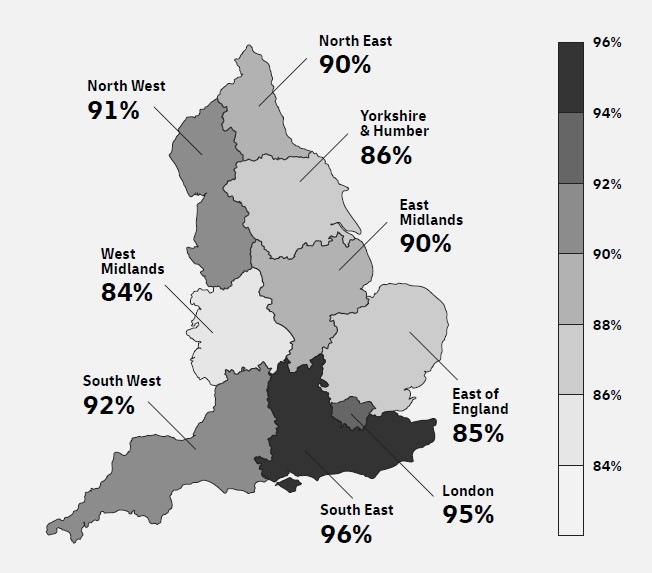
Availability by region
 

Source: Retail Economics, DHL Supply Chain


London and the South East show the highest availability, supported by dense store networks and robust delivery infrastructure. Frequent replenishment and proximity to distribution hubs sustain strong shelf performance in these high-demand areas.

Elsewhere, availability remains broadly stable, reflecting a resilient national model across diverse geographies.


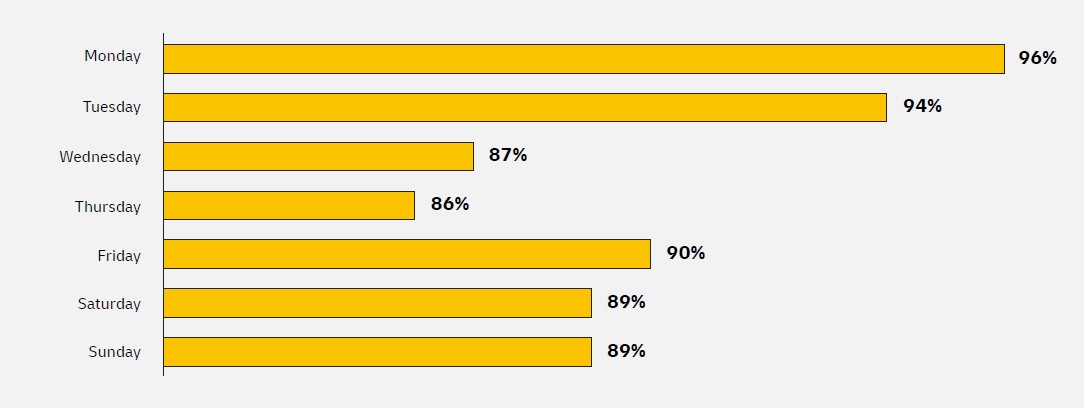
Availability by day of the week
Source: Retail Economics, DHL Supply Chain


Availability peaks early in the week as stores recover from weekend trading and fresh deliveries enter the network. Midweek dips reflect lighter delivery volumes, leaner replenishment schedules, and promotional changeovers that can temporarily disrupt shelf stability.

Levels rise again heading into the weekend as retailers rebuild stock ahead of higher footfall.


Shopper tolerance to stock gaps

Our research highlights how quickly consumer patience runs out when encountering missing items. While overall availability remains high, even small gaps can have a noticeable impact on trust – particularly for the main weekly shop. Multiple ‘out-of-stock’ moments on a single trip can quickly escalate frustration, damaging perceptions of reliability and loyalty.

Across all audits, 82% of stores had at least one item missing from a typical weekly shop, and nearly two-thirds (64%) recorded two or more missing items. Smaller-format stores were most exposed, with limited ranges, lean staffing, and faster turnover heightening the risk and visibility of gaps.


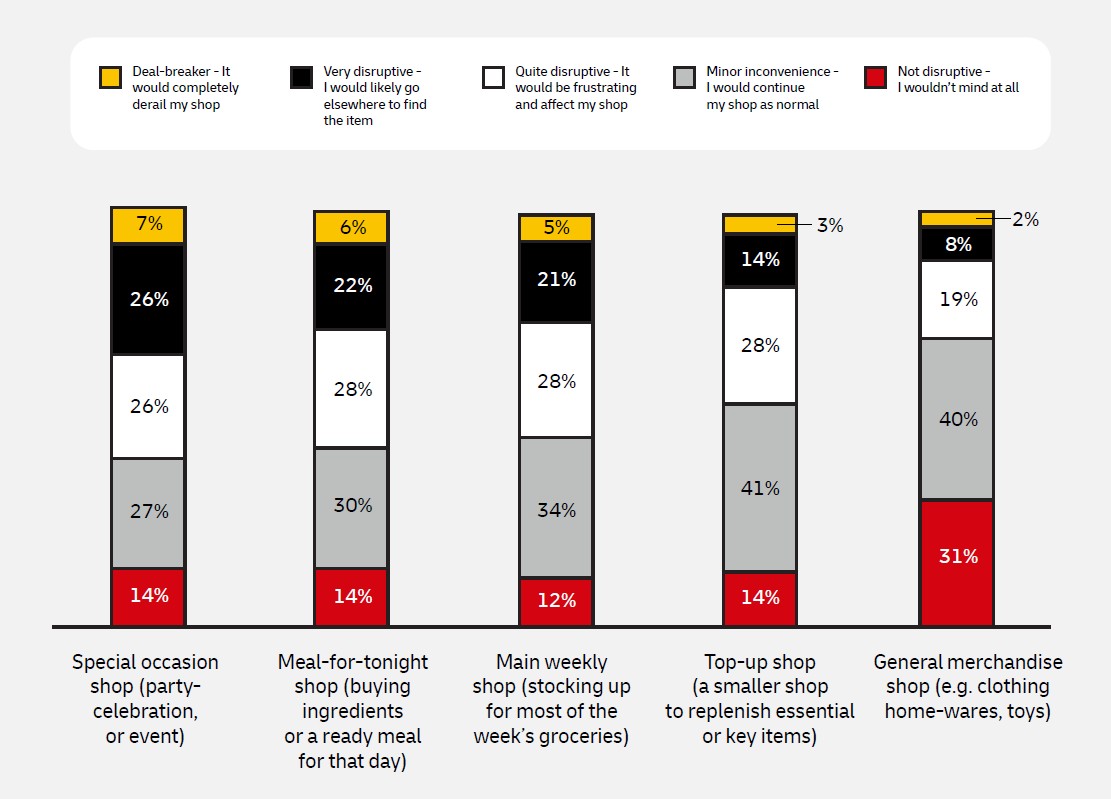
If an item you are looking for is not available (and there is no suitable alternative), how disruptive would that be depending on the type of trip?
Source: Retail Economics, DHL Supply Chain


Not all ‘gaps’ are equal. Shopper tolerance for missing items varies sharply depending on the type of trip and the products involved. For example, a stockout during a top-up shop could just be a mild inconvenience, but might be a deal-breaker when shoppers are meal planning for entertaining.

Our research confirms that ‘meal-for-tonight’ and ‘special-occasion’ shops are the most sensitive missions, with around three in five shoppers saying a missing item would disrupt their shop and often lead to a secondary trip. Top-up or non-food missions, by contrast, carry much higher tolerance. Here, shoppers can delay, substitute, or shop elsewhere later with minimal disruption.


Mission matters: why some gaps hit harder than others

For retailers, this underscores that context shapes consequence. Operational excellence during ‘mission-critical’ shops (especially in evenings and weekends) delivers disproportionate gains in satisfaction and loyalty. Small lapses in these moments carry far greater weight than gaps elsewhere.


Section 2: The consumer reality

Expectations, tolerance and trust

This section examines how shoppers experience and interpret stock gaps in practice, from how much they notice and tolerate them, to how these moments shape perceptions of value and trust. It explores five behavioural themes that reveal what availability really means to consumers today, and how these expectations influence loyalty.

This section examines how shoppers experience and interpret stock gaps in practice, from how much they notice and tolerate them, to how these moments shape perceptions of value and trust. It explores five behavioural themes that reveal what availability really means to consumers today, and how these expectations influence loyalty.


Reliability redefined: Availability at the core of value perception

Availability has always been a pillar of grocery excellence, but its influence on where consumers shop is now more visible. In this context, it reflects not just whether a product is on the shelf, but whether a retailer can deliver consistently across stores, categories and missions.

Our research shows that one in three consumers now rate product availability as more important than price when deciding where to shop. This doesn’t signal a decline in price sensitivity; it highlights that reliability defines whether value is delivered in practice. A well-curated range or sharp price point only matters if shoppers can complete their shop.


Today, shopper value extends beyond price. Reliability underpins the five pillars of perceived grocery value (as seen in the below diagram). If shoppers can’t buy the deal, the deal doesn’t matter.

Availability carries extra weight for young families with children and affluent households - high-spend and high-frequency shoppers. These customers typically have larger basket sizes and plan fuller missions, making them more exposed to out-ofstocks.

For time-pressed households balancing work, family and rising living costs, a missing item isn’t just a minor irritation. It can mean making additional trips, changing meal plans, or disappointing a child!

Grocery Value Equation 

Source: Retail Economics, DHL Supply Chain


Availability in convenience: small formats, high stakes

The leading grocers are expanding convenience and forecourt estates at pace, reflecting how shopping habits continue to shift towards smaller, more frequent trips.

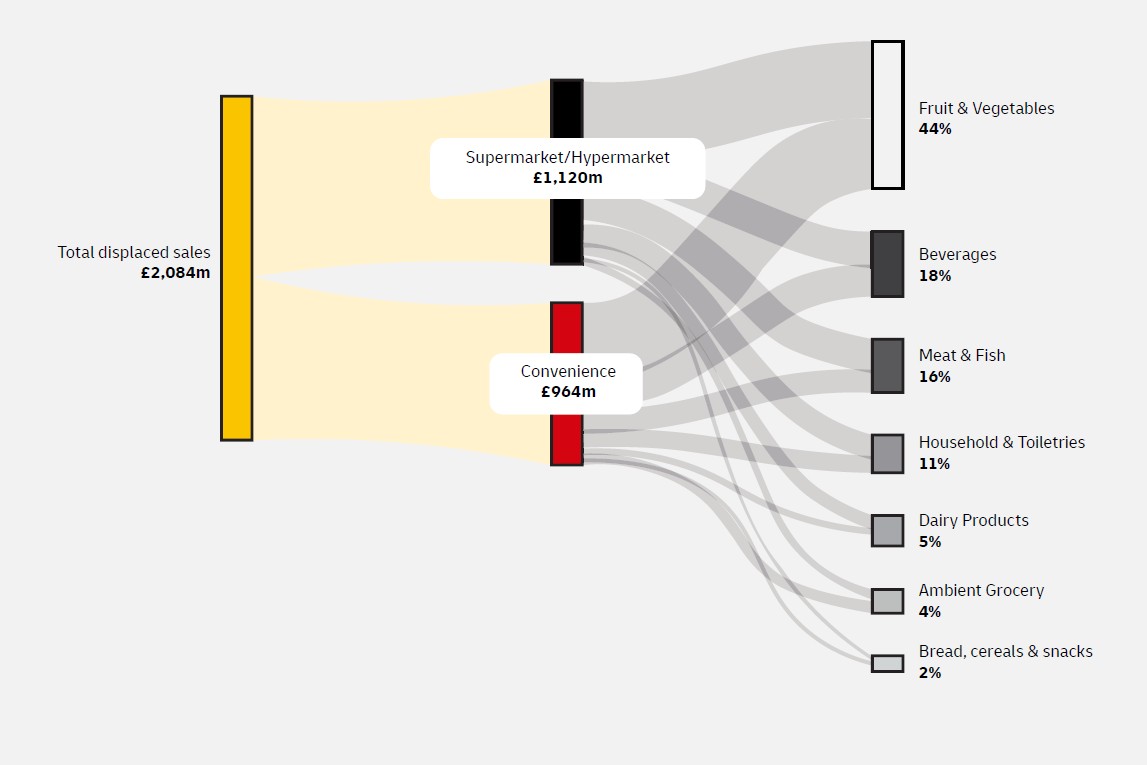
Hybrid working, smaller households and busier lifestyles have made convenience stores a fast-growing segment - the go-to format for top-ups, forgotten essentials, on-the-go and meal-for-tonight missions. However, as this format grows in prominence, the challenge of maintaining full shelves has intensified. Convenience stores represent around one-fifth of grocery sales yet account for almost half of all displaced spend.

Our audit found availability rates for convenience stores typically sit in the low-to-mid-80% range, compared with supermarkets and hypermarkets operating well into the 90s. Closing that gap would deliver a meaningful commercial uplift.

Consumers are aware of this difference: two in three (63%) say stock availability is lower in convenience stores than in larger supermarkets. This tension reflects both operational and demand-side realities.

The combination of rising shopper expectations and compact operational models explains why convenience formats have lower availability rates. But it also highlights the opportunity: these high-velocity, high-visibility stores are where marginal improvements in on-shelf performance can deliver outsized returns.


Convenience formats carry a disproportionate share of sales at risk from stock gaps
Source: Retail Economics, DHL Supply Chain


Everyday essentials and perceived reliability

The items that cause the most frustration if unavailable are everyday essentials that anchor household routines like toilet roll, milk and bread. Shoppers expect to find these always available, and when they’re not, the reaction is immediate and emotional.

Audit data shows on-shelf availability across these top 10 items averaged 92%, rising to near-perfect levels once acceptable substitutes are included. Yet when a preferred brand or SKU is missing (especially in visible, high-frequency categories), shoppers still perceive it as a failure, even when an alternative is available.


Section 3: Turning availability into an advantage: Strategic focus points for retailers 

Availability has always defined grocery excellence, but the challenge has evolved.

Today’s customers shop across multiple channels and missions, expect instant access to products, and have little tolerance for disruption. Combined with tighter margins and greater demand volatility, this complexity is testing even the most advanced supply chains.

The next phase of competitiveness will come from using technology, data, and collaboration to make availability predictable, flexible, and seamlessly executed end-to-end.

To stay ahead, grocers must evolve availability from a store-level metric into a connected, predictive, and resilient system.


Our research highlights five focus points:

• Predict and prevent with AI-driven foresight.

• Strengthen supplier collaboration to improve end-to-end execution.

• Design availability for mission-critical shops where consequence is highest.

• Build resilience for disruption through data, flexibility and network agility.

• Embed availability as a daily brand promise, not just an operational KPI.


Conclusion

Product availability has become the defining pressure point in UK grocery. In one of the world’s most competitive retail markets, even small gaps can have big consequences. One in five shopping trips now involve at least one missing item, costing around £2.1 billion in displaced sales each year and eroding shopper confidence in reliability.

Today’s consumers are more mobile, informed and selective. They shop across multiple retailers and channels, and when shelf gaps appear, it often impacts loyalty with low tolerance levels and frustration. Availability has become a subtle but decisive factor in where and how people choose to shop. It’s become a currency of trust that underpins loyalty in an era of effortless comparison and low switching costs.

 

Download: The Availability Effect: Why trust, margin and loyalty start at the shelf edge report

*All fields required

Don’t worry, your phone number and personal data are kept confidential. We never sell, rent or pass on your details to a third party.

NOTE: We will never sell, rent or pass on your details to a third party.

Find out more about our complete end-to-end thought leadership service

Discover our proven five step process & avoid the complex multi party approach

  • Say something new & insightful
  • Use our extensive experience to inject real industry value
  • Get maximum engagement from our media networks
  • Develop an authoritative voice within UK retail
  • Be seen as an industry leader!

DISCOVER NOW

📥 Download the report now to explore the full audit findings, consumer tolerance modelling and strategic focus points for retailers.

About this report

The Availability Effect, conducted by Retail Economics in partnership with DHL Supply Chain, analyses how stock gaps are reshaping trust, loyalty and commercial performance in UK grocery. Combining in-store audits across 100+ locations, a nationally representative survey of 2,000 households, and economic modelling, the report quantifies £2.1bn of annual sales at risk from availability issues. It explores the behavioural thresholds that trigger switching and outlines strategic priorities for turning availability into competitive advantage.

View All THOUGHT LEADERSHIP REPORTS

Other popular thought leadership reports

Retail transformation and resilience research by Zühlke and Retail Economics

Report

Adapt now or disappear: Digital maturity in European retail

How retailers are redesigning operating models, technology and culture to drive resilience
Delivery courier fulfilling ecommerce parcel in urban environment

Report

Ecommerce Delivery Benchmark Report 2026

A 2026 benchmark of ecommerce delivery performance across UK retail.
From blind spot to retail advantage report cover – GNFR hidden costs and savings in uk fashion retail

Report

From blind spot to retail advantage: GNFR costs

How uk fashion retailers can turn GNFR from a blind spot into a margin and reinvestment lever
Cover of the Retail workforce reimagined report by Eversheds Sutherland and Retail Economics

Report

Retail workforce reimagined: The transformative power of AI

How AI is reshaping retail jobs, productivity and workforce strategy.
Cover of the UK retail and leisure outlook 2026 preview report by Retail Economics

Report

UK Retail and Leisure Outlook Report 2026

Deep dive into what will drive growth for consumer-facing businesses in the year ahead.
Unbox report cover – social commerce research by Retail Economics

Report

The billion-dollar battleground of social commerce

How social platforms are turning discovery, impulse and creator influence into a multi-billion-pound retail channel.
The future of search and discovery report cover by Retail Economics in partnership with AWS, Botify and DataDome

Report

The Future of Search and Discovery: A Strategic Playbook to Understand Agentic Commerce

A strategic playbook for retailers as AI agents reshape search and discovery
Cover of the Shades of Z report by Retail Economics and RSM

Report

Shades of Z: Decoding the next generation of consumers

How Gen Z is redefining retail behaviour, brand loyalty and future growth strategies
Cover of ‘The Commuter Pound’ report by KBH and Retail Economics

Report

The Commuter Pound: How rail journeys create Britain’s most valuable shopping hour

How rail commuter's creates a high-value audience for retail, media and brands.
ZigZag returns benchmark 2025 cover showing UK fashion returns insights

Report

ZigZag returns benchmark 2025 – Lessons from 100 online returns

Benchmark returns performance across 100 UK fashion retailers and see how fees and friction are reshaping behaviour
InPost delivery lockers x Retail Economics Report

Report

Beyond the doorstep: The evolution of lockers in the new age of unified delivery

Exploring parcel lockers, sustainability and consumer convenience in UK retail
UK retailer navigating global trade headwinds

Report

Crossing Borders: How UK Retailers are Navigating Trade Turbulence to Unlock Global Growth

How UK retailers respond to trade turbulence, leverage new markets and agile fulfilment to drive growth.
Explore how leading brands are closing the unified commerce gap and turning complexity into competitive advantage

Report

Unified Commerce: From fragmentation to connected experiences

Learn how retailers are moving from fragmented journeys to connected experiences with unified commerce
unified commerce retail strategy

Report

The race to unified commerce: how UK retailers are navigating disruption and redefining strategy

Discover how retailers are modernising tech, integrating operations, and reshaping their models for unified commerce.
Retail Resilience 2025 – Retail Economics and Barclays

Report

Retail resilience in 2025 – Turning disruption into competitive advantage

How leading UK retailers are building resilience across AI, ESG, cyber security and crisis management
Report cover showing digital payments and technology icons overlayed on a retail background

Report

Payment resilience in an uncertain world

How payment resilience is helping retailers reduce fraud, build trust and adapt to uncertainty
Report on retail operating costs and profitability economics

Report

Unlocking Retail Profitability: Transforming a Cost Crisis into a Competitive Edge

Discover how leading retailers are transforming frontline operations to offset rising costs and unlock profitable growth.
Know Your Shopper report cover – Retail Economics and Vypr research on loyalty, membership pricing and consumer behaviour 2025

Report

Know your shopper: Retail Loyalty & Membership Pricing

Exclusive insights on loyalty, membership pricing and shopper behaviour from Retail Economics and Vypr.
ecommerce delivery benchmark report 2025 retail economics

Report

Ecommerce Delivery Benchmark Report 2025

Unlock key ecommerce trends for 2025: Discover how AI, social commerce, and unified delivery drive growth. Download now!
How Ai drives consumer discovery and retail spend

Report

From Search to Sale: How AI Drives Consumer Discovery and Retail Spend

Discover how AI-powered search influences £31.4bn in retail spend and reshapes the path to purchase
Outlook for UK retail 2025 - retail economics

Report

Retail and Leisure Outlook Report 2025

Get a sneak peek at the Outlook for UK Retail & Leisure 2025 report: Macroeconomic and consumer behaviour insights with actionable strategy
Transformative AI - Maximising efficiency while minimising carbon Retail Economics

Report

Transformative AI: Maximising efficiency while minimising carbon

Explore how AI is transforming retail from both sides of the till, impacts and strategies for implementation.
Online ecommerce customer loyalty and delivery Amazon Shipping and Retail Economics

Report

Customer loyalty begins at the doorstep: Enhancing relationships through delivery excellence

Discover how delivery can drive loyalty and boost satisfaction in ecommerce. Get the key insights now!
Recommerce used second-hand spending at Christmas retail economics

Report

Recommerce Christmas 2024: Measuring the impact of second-hand on retail spending behaviour

Explore the £2B second-hand Christmas boom in 2024 and discover the strategic insights you need this festive season
The Material Change Index DS Smith Retail Economics plastic packaging

Report

The Material Change Index: Unpacking the scale of plastic packaging and opportunities for change in European supermarkets

Download our groundbreaking study revealing how European supermarkets could eliminate 154 billion pieces of plastic packaging
Cost of Online returns retail economics

Report

The Cost of Serial Returners in 2024

Discover how £27bn in returns are eroding retail profits, and why just 11% of customers are responsible. Download the benchmark report
Children spending behaviour in retail consumer economics

Report

Tomorrow's Consumers: Exploring how and where children spend their money

Find out how & where children in the UK spend their money, having analysed 8 million card transactions of 6-17yrs
Retail Resilience business models report Retail Economics Barclays

Report

The Retail Resilience Report

Check out our Retail Resilience Framework to help assess your business model & retailers top risks & preparedness
Social media commerce economics tiktok

Report

The Power of Social Commerce: Building brands in the TikTok era

See how brands are leveraging social media & TikTok to enhance brand awareness & sales with entertainment and stories
Brexit to Breakthrough

Report

From Brexit to Breakthrough: UK Brands Embrace Marketplaces for Global Success

Explore how UK retailers adapt to Brexit by leveraging digital marketplaces for international growth and resilience
Basket Abandonment 2

Report

Battling Basket Abandonment Report: No Margin for Error in Zero Tolerance Era

Explore key strategies to combat the £34.4B impact of UK basket abandonment in 2024
Communication & Solving Consumer Pain

Report

Omnichannel Communication & Solving Consumer Pain Across The Customer Journey

Unlock 2024 UK retail insights: consumer trends, pain points, and strategic retail solutions in our detailed report
Impact of delivery lockers on UK retail

Report

Delivery Lockers: Unlocking the Final Mile

Explore the impact of delivery lockers on UK retail, consumer preferences, and sustainable urban logistics
Consumer and Retail Trends in 2024

Report

Taking Stock 2024 - UK Retail & Consumer Trends

Learn what 2024 holds in store for UK retail and consumers & discover key trends to look out for in 2024 and beyond.
Customer Affluence and the Wealth Effect - Retail Economics, beBettor

Report

Customer Affluence and the Wealth Effect: Strategies for Retail Growth

Find out how customer affluence insights can improve retail marketing strategy
Net Zero commitments of brands and retailers

Report

The Path to Net Zero - The future of the retail industry

This report evaluates net zero efforts of the top 200 retailers/brands with DTC operations in global markets.
Outlook for the UK Retail & Consumer Industry 2024 - Retail Economics

Report

Retail and Leisure Outlook Report 2024

Learn about the Outlook for UK Retail & Leisure in 2024: With insights to help businesses thrive in a complex landscape
Report about new customer journeys, the importance of omnichannel & the role of delivery/logistics - Retail Economics

Report

Ecommerce Delivery Benchmark Report 2024

Explore the intricacies of new customer journeys, the importance of omnichannel & the role of delivery/logistics.
The Psychology of Recommerce

Report

Second-Hand, First Choice: The Psychology of Recommerce

Discover key industry and consumer insights and strategies for businesses to implement as recommerce continues to evolve
The Cost of Retail Theft

Report

The Cost of Retail Crime: Financial Impacts & Mitigation Strategies

Discover the motivations behind employee retail theft and strategies to minimise theft within the workplace
Digital Wallets in Retail

Report

From Plastic to Pixels: Navigating Shifts in Consumer Payment Preferences

A look into the trajectory for digital wallets across UK retail, leisure & hospitality + strategic considerations
Peak Trading Season Report

Report

Peak Season Report 2023: Building a risk-resistant ecommerce strategy

Discover what Christmas 2023 has in store for retail and how consumer behaviours will affect it + strategies for success
New Age of Digital Transformation

Report

Retail at Inflection Point: A New age of Digital Transformation

Discover the impact of digital sophistication on financial indicators inc. sales growth, profitability & valuation
The cut back economy a widening crisis within the retail industry

Report

The Cut Back Economy 2023: A Widening Crisis

Part 2 of our Cut Back Economy series, this report identifies opportunities & risks to navigate the cut back economy
Consumer and Retail Trends in 2023

Report

Taking Stock - UK Retail & Consumer Trends

Learn what 2023 holds in store for UK retail and consumers & discover key trends to look out for in 2023 and beyond.
Top 10 European Retail Markets

Report

Top 10 European Retail Markets: In-store & Online Spending Data (2013-2022)

Data and Insights on the Top 10 European Retail Markets consolidated into one report
Personalisation Pays Reshaping Retail

Report

Personalisation Pays: How Data-Driven Strategies are Reshaping Retail

Discover how data-driven strategies are changing retail as we know it and how personalisation can help businesses thrive
The Bottled Water Industry

Report

An Economic and Environmental Case for Acting Against Bottled Water Packaging, Labelling and Marketing in the UK

Discover the economic and environmental case against bottled water packaging in the UK. Take a stand for a sustainable future.
Battling Basket Abandonment - GFS & Retail Economics

Report

Battling Basket Abandonment: Mastering Delivery Choice & Convenience

Discover more information about why consumers abandon their online shopping baskets and how to reduce these abandonments
Outlook for the UK Retail & Consumer Industry 2023 - Retail Economics

Report

Outlook for UK Retail & Consumer 2023

Learn about the Outlook for UK Retail & Consumer in 2023: Cost of living impact on consumer behaviour & retail brands.
The Future of Retail Property Preview Report - Retail Economics

Report

The Future of Retail Property

Check out the Future of Retail Property preview report. Full access available to Retail Property Members only.
40 future retail trends to 2030 - Retail Economics

Report

40 Future Retail Trends to 2030

Discover the top 40 retail trends shaping the future towards 2030: a great resource to help future-proof your business
Retail insight report on consumer shopping behaviour online vs. in-store

Report

UK Omnichannel Retail 2023: Understanding Consumer Segmentation for In-store & Online Markets

Find out where shoppers are spending: online vs. in-store for key retail categories + impact of age, income & workplace.
Report about the impact of inflation & changing consumer behaviour on the retail sector - Retail Economics

Report

Ecommerce Delivery Benchmark Report 2023: Impact of inflation & consumer behaviour on online retail

Learn about the impact of inflation & changing consumer behaviour on the retail sector: spot opportunities & challenges.
The Future of the EU Apparel Industry Business Models  Profitability Retail Economics

Report

The Future of the European Apparel Industry: Business Models & the Profitability Paradox

This report looks at the future of the apparel industry & how business models are adapting to profitability concerns.
Christmas 2022 Retail Sales: Holiday Shopping Trends Report - Retail Economics

Report

Christmas 2022 Retail Prospects: Holiday Shopping Trends Report

Christmas 2022 retail sales prospects? This report assesses performances across peak trading in ‘cost of living’ crisis.
uk pensions report - retail economics

Report

Understanding Pensions in an Era of Disruption

Discover how much savings & income you need for retirement & the shortfall between current pension pot values & income.
Changing consumer and shopper values in retail

Report

Changing Consumer Values & Behaviour: Building a Competitive Proposition in Retail

Consumer behaviour across Europe is changing in response to industry disruption & the cost of living crisis - see how.
The cut back economy cost of living crisis retail economics

Report

The Cut Back Economy & Cost of Living Crisis

Explore the key drivers & impacts of the cost of living crisis on UK retail & what brands can do to mitigate its effects
The apparel market Five key trends to 2025

Report

The Apparel Market: Five Key Trends to 2025

Learn about the five key industry trends that will shape the apparel sector towards 2025 (clothing & footwear).
The Retail Experience Economy 2.0 report - How Consumers value experiences in times of crisis - Retail Economics

Report

The Retail Experience Economy 2.0

Find out how the experience economy is being impacted by the cost of living crisis & many other factors.
Top five strategies for retailers and brands to combat rising inflation and operating costs - Retail Economics report

Report

Top 5 strategies for retailers & brands to combat rising inflation & operating costs

Discover our top 5 strategies for retailers & brands to help combat rising inflation & operating costs.
The Big Squeeze Report pressure on consumer finances and rising inflation - Retail Economics

Report

The Big Squeeze: Pressure on consumer finances, rising inflation & money management

Discover the 4 financial personas of consumer spending & how rising inflation & household bills are impacting behaviour
Impact of the metaverse on the retail industry sector - Retail Economics

Report

Impact of the metaverse on the retail industry

Is the metaverse going to be the next big thing? Download our report to find out what retailers should be thinking about & how customer journeys could change.
Ecommerce Delivery Benchmark Report 2022 - Retail Economics - Metapack

Report

The Future of Online Delivery for the Retail Industry

Discover the impact of the ongoing shift to online retail within key European markets & how it's affecting consumer behaviour & retailer's operations.
Future of European Apparel Industry - Evolution of Stores - Retail Economics

Report

Future of European Apparel Industry: Evolution of Stores

See where the future of the European apparel industry is heading & how physical stores & their purpose is fast evolving.
Outlook for UK Retail & Consumer Industry 2022 - Retail Economics

Report

Outlook for the UK Retail & Consumer Industry 2022

Get your free Outlook for UK Retail 2022 report: economic outlook, forecasts, Covid-19 impacts, online, supply chains...
Covid-19 and the Future of UK takeaway industry - Retail Economics

Report

Covid-19 and the Future of Takeaway

This report looks into the valuable economic, social and cultural contribution made by the UK takeaway sector in 2020.
UK Food and Grocery Market Retail Trends to 2025 - Retail Economics

Report

The UK Grocery Market: Five Key Trends to 2025

This report explores five emerging retail trends in the Food & Grocery sector towards 2025 (consumer behaviour, online).
The True Cost of Online Retail - Retail Economics

Report

The True Cost of Online Retail

This research looks at the online retail channel & investigates the real operating costs & profit margins for retailers.
Outlook for UK Retail 2021 - Ten retail trends - Retail Economics

Report

Outlook for UK Retail and Leisure 2021

This report looks at challenges facing UK retail in 2021 in context of Covid-19 & other key structural changes unfolding.
Covid-19 and the Future of Retail Supply Chains - Retail Economics

Report

Covid-19 and the Future of Retail Supply Chains

This report explores retail supply chain networks & key disruptive factors: Covid-19, security, labour, technology, ESG etc.
Connected digital retail customer journey - Retail Economics

Report

The Connected Retail Customer Journey and Digitalisation

Explore the connected retail customer journey & the importance of digital as online engagement soars in this current era.
Retail Customer Journey Fashion Apparel Industry - Retail Economics

Report

Understanding the retail customer journey for the fashion industry

Discover insight into the retail fashion customer journey (stage 1) - consumers first interact with retailers & brands.
Brexit disruption Food & Grocery - Retail Economics

Report

Structural Changes for UK Food & Grocery Sector

In a pre-Covid era, this research report looks at consumer behaviour & the impact of Brexit on how consumers shop for Food.
Economic Outlook for UK Retail and Impact of Covid-19 - Retail Economics

Report

Economic Outlook for the UK Retail Industry and the Impact of Covid-19

Explore the outlook for the UK retail sector & 5 underlying trends that will reshape the industry from Covid-19 impacts.
Consumers and the New Normal - Exploring Covid-19 impact on EU retail

Report

Consumers and the New Normal: Exploring the impact of the coronavirus on European retail

What is the 'new normal' going to look like for retail in the EU? This report examines this in detail & offers insight.
Contribution of the UK takeaway market to the economy - Retail Economics

Report

The Contribution of the Takeaway Market to the UK Economy

How does the UK takeaway industry impact the UK economy? This report looks at the valuable economic & social contribution.
Retail Cash Crunch Impact of Covid-19 - Retail Economics

Report

The Retail Cash Crunch: The Impact of COVID-19 on Major Non-Food UK Retailers

How long can UK retailers' cash reserves last? This report looks at Covid-19 impacts, consumer behaviour & profit margins.
Whats happening to retail property?

Report

What's happening to Retail Property?

Exploring the contributing factors of how physical retail property is changing: rise of online, shopper behaviour & more.
Impact of Artificial Intelligence (AI) on the UK retail industry - Retail Economics

Report

The impact of AI on the UK retail industry

A look into how artificial intelligence (AI) is impacting the UK retail industry, at all stages of the customer journey.
Future of online retail in the UK  - Retail Economics

Report

The Digital Tipping Point: 2019 Retail Report

Unearths insights into causative forces driving digital customer journeys & reveals differences across consumer segments.
Impact of Covid-19 on UK retail industry - Retail Economics

Report

Impact of the Coronavirus on Retailers

This report explores the impact of the initial stages of Covid-19 on the UK retail & leisure industry back in March 2020.
Outlook for UK Retail 2020 - Retail Economics

Report

2020 UK Retail and Leisure Outlook

The outlook for the UK retail industry 2020 from a pre-Covid-19 perspective. Research, commentary & analysis of factors.
Outlook for UK retail 2019 - Retail Economics

Report

Retail Economics/RBS Outlook for UK Retail 2019

Find out what's in store for UK retail in 2019 & beyond. Discover current factors affecting retailer and consumer alike.
The Retail Experience Economy - The Behavioural Revolution - Retail Economics

Report

The Retail Experience Economy: The Behavioural Revolution

This work explores four realms of retail experiences that have been quantified & discusses their impact shopper behaviour.