The state of AI in European retail marketing & E-commerce
DOWNLOAD FREE REPORT
7 minute read
Why AI advantage in European retail will be won through integration, not experimentation
We surveyed 300 retail decision-makers across Benelux, DACH, the Nordics and the UK to assess how AI is being embedded across marketing and e-commerce
AI adoption in European retail has reached a tipping point. What was once a frontier capability is now widespread across marketing and e-commerce functions. From content generation to campaign optimisation, retailers are actively testing AI to improve efficiency, decision-making and customer engagement.
However, adoption alone is not translating into advantage. While most retailers are experimenting with AI, only a small minority have embedded it deeply enough to deliver consistent, scalable commercial returns. This report explores that gap — revealing why integration, organisational readiness and data maturity are now the defining factors separating AI leaders from the rest.
What you can learn from this report
• How to distinguish early AI activity from genuine maturity in retail marketing and e-commerce.
• Why personalization is the clearest test of whether AI is embedded into workflows and decision-making.
• Where organisational, cultural and technical barriers are limiting ROI from AI investments.
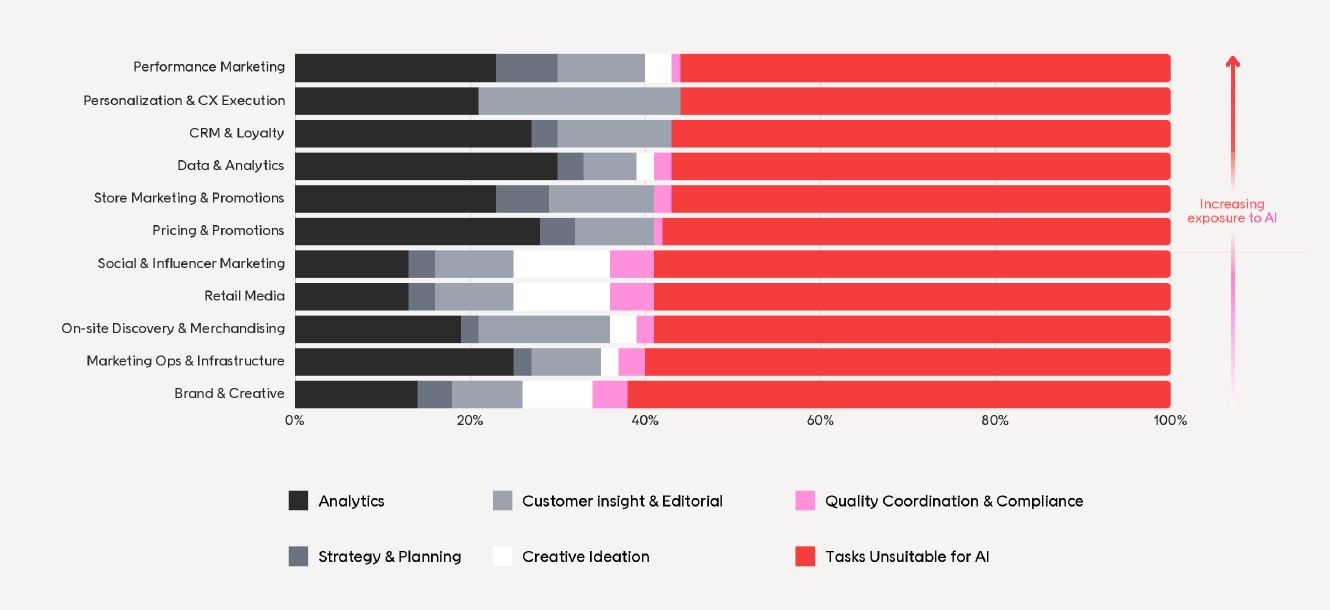
• Which functions are most exposed to AI disruption and where future value will concentrate.
• What it takes to move from fragmented pilots to scaled, commercially impactful AI deployment.
Key report insights
• 95% of retailers are experimenting with AI, yet only 5% report clear, scalable ROI.
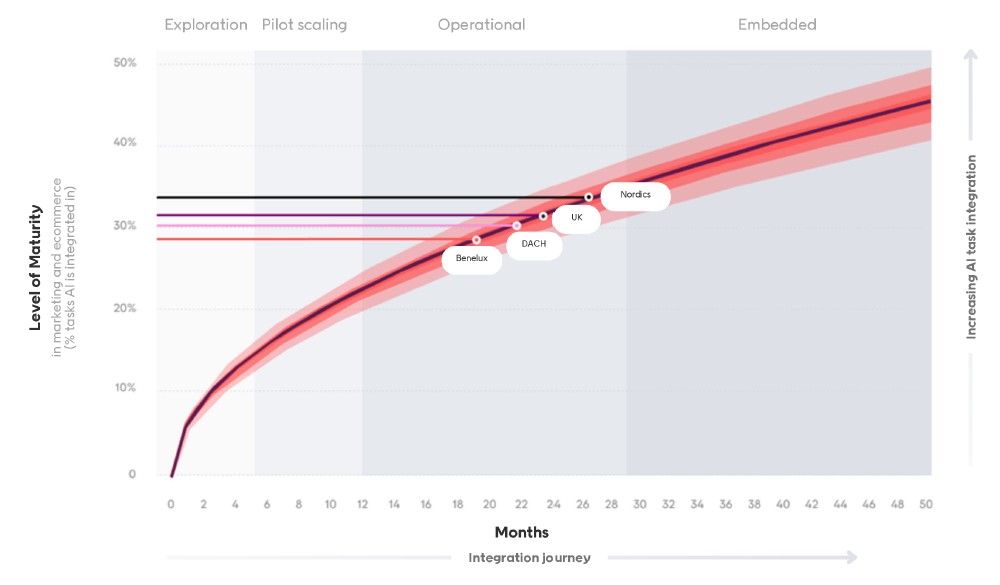
• 45% of retailers are operating AI at an “operational” level, but only 26% have reached embedded maturity.
• The Nordics lead AI maturity at 35%, followed by the UK (32%), DACH (30%) and Benelux (29%).
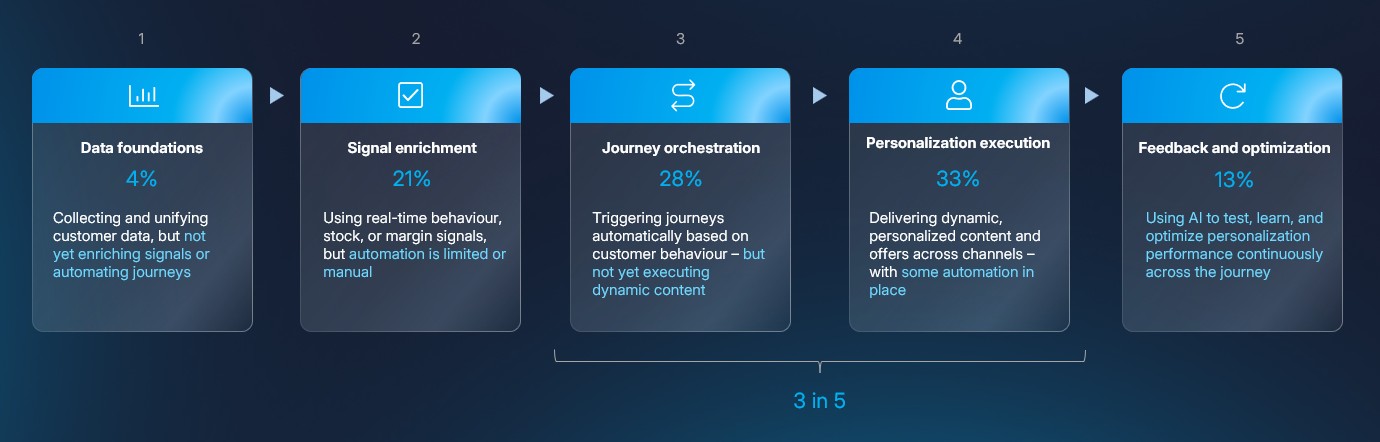
• Only 13% of retailers have fully optimised, self-learning personalization systems in place.
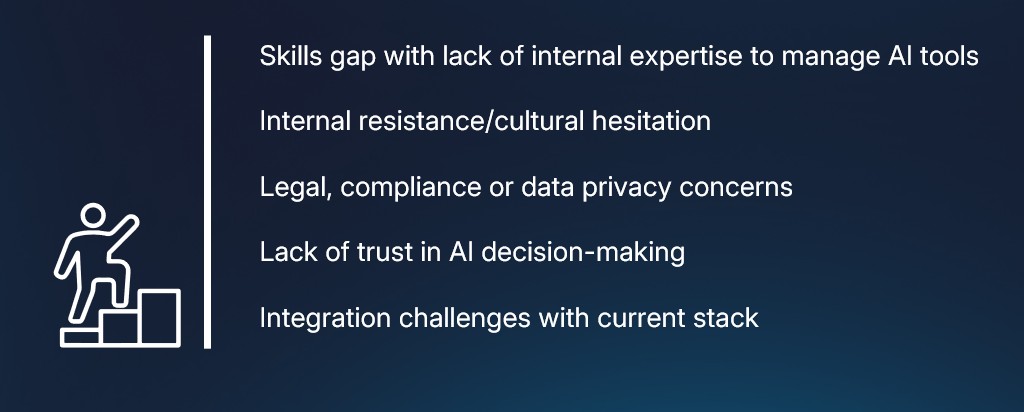
• 58% cite skills gaps as the biggest barrier to scaling AI adoption.
• 57% report internal resistance or cultural hesitation as a key constraint.
• €14.9bn of marketing and e-commerce spend is expected to be influenced by AI by 2030.
Understanding the AI maturity gap
AI maturity varies across Europe, but the differences between regions are narrower than expected. Even in leading markets such as the Nordics, only around a third of marketing and e-commerce activities are currently supported by AI. This highlights how early the industry still is in its transition from experimentation to full integration.
More importantly, the research shows that maturity is less about geography and more about internal capability. Retailers that are progressing fastest are those that have unified customer data, aligned teams around shared AI use cases, and embedded AI into operational workflows rather than treating it as a standalone tool.
Regional variation in AI maturity
Source: Retail Economics, Voyado
From signals to personalization at scale
Personalization provides one of the clearest lenses through which to assess AI maturity. It requires the combination of high-quality data, decisioning logic and execution across channels — making it a strong proxy for how well AI is embedded within an organisation.
The five-stage maturity model highlights a clear progression: from basic data collection to signal enrichment, journey orchestration, dynamic execution and ultimately continuous optimisation. While many retailers are advancing into orchestration and execution, relatively few have reached the stage where AI is autonomously optimising performance in real time.
The five stages of AI-driven personalization
Source: Retail Economics, Voyado
Why scaling AI remains difficult
Despite strong momentum, retailers face a consistent set of barriers that prevent AI from scaling effectively. The most significant challenge is not technology itself, but the organisational environment required to support it. Skills shortages, internal resistance and governance concerns all combine to slow progress beyond pilot stages.
These constraints highlight a critical shift in focus. The competitive advantage will not come from access to AI tools — which are increasingly commoditised — but from the ability to integrate those tools into workflows, align teams around them, and trust their outputs in live decision-making environments.
Top 5 barriers to using AI agents for marketing or loyalty journey automation
Source: Retail Economics, Voyado
Where AI will create the most value
AI’s impact is not evenly distributed across retail functions. Activities that are data-rich, repeatable and closely tied to commercial outcomes — such as performance marketing, CRM, pricing and analytics — are significantly more exposed to AI-driven transformation.
By contrast, functions that rely more heavily on creative judgement, coordination or compliance will see a slower rate of automation. This uneven exposure reinforces the need for retailers to prioritise investment in areas where AI can compound value most rapidly, rather than attempting blanket adoption across all functions.
Exposure varies by function
Source: Retail Economics, Voyado
Conclusion
AI in European retail is entering a new phase. The question is no longer whether retailers are using AI, but whether they are using it in a way that delivers sustained commercial impact. The gap between experimentation and execution is now the defining competitive frontier.
Those that succeed will move beyond isolated use cases and build integrated AI capabilities across data, decisioning and execution. In doing so, they will not only unlock efficiency gains, but reshape how value is created across the entire marketing and e-commerce ecosystem.