Agentic commerce: The new test of trust and loyalty
DOWNLOAD FREE REPORT
10 minute read
Agentic commerce: why AI is becoming the new test of retail trust and loyalty
Understanding how AI-driven journeys are exposing the operating models behind retail performance
Retail is entering a new phase where AI increasingly shapes how shoppers discover, evaluate and interact with brands.
From AI assistants helping consumers compare products to agentic systems capable of acting on behalf of shoppers, customer journeys are becoming faster, more automated and increasingly mediated beyond traditional retailer-controlled channels.
This evolution raises the stakes for operational performance. In an AI-enabled environment, weak execution becomes harder to conceal, while reliability, fulfilment, transparency and service quality become more visible signals of trust. As AI compresses the path to purchase, loyalty is increasingly determined by how consistently retailers can deliver when experiences do not go to plan.
What you can learn from this report
• How AI assistants are becoming embedded within everyday shopping behaviour across different consumer generations.
• Why trust, reassurance and operational consistency are becoming critical differentiators in AI-enabled retail journeys.
• How AI can amplify operational weaknesses and accelerate switching when customer experiences fail.
• The emerging differences between on-site retail AI ecosystems and off-site AI discovery platforms.
• Which strategic priorities retailers should focus on to secure loyalty in an increasingly automated retail environment.
Key report insights
• Around seven in ten UK consumers have used large language models in the past 12 months, with 38% already using them for shopping-related tasks.
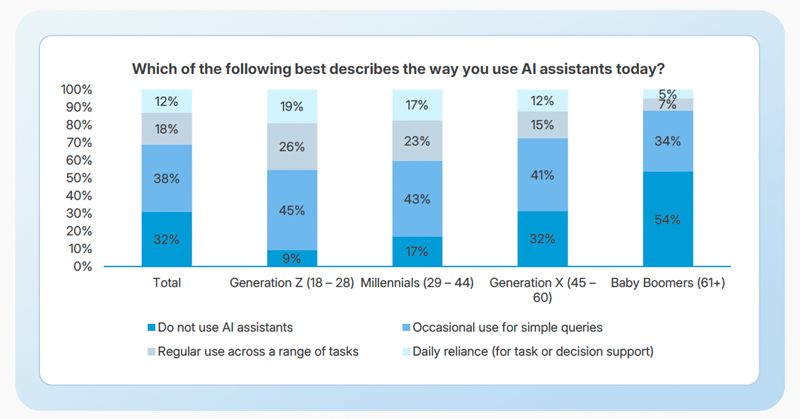
• Generation Z shows the highest AI engagement, with 45% regularly using AI assistants across a range of tasks and 19% relying on them daily.
• Only 11% of shoppers are truly AI-first, while 53% remain Guided decision-makers who still retain control over final purchasing decisions.
• Nearly half of consumers (49%) still prefer to conduct product discovery themselves, showing trust in AI remains uneven.
• While 95% of retailers are investing in AI, only around 5% report clear scalable ROI from these investments.
• AI systems amplify operational realities, meaning inconsistent delivery, opaque pricing and poor service become more visible to customers.
• Retailers with integrated operating models are better positioned to use AI to reinforce trust, improve conversion and deepen customer loyalty.
AI adoption is accelerating across generations
The pace at which AI has entered everyday consumer behaviour is unprecedented. Conversational AI platforms now attract almost 900 million users a month, reshaping how customers discover, compare and engage with products and services.
However, adoption varies significantly by age group. Younger consumers are embedding AI more deeply into daily routines, while older generations remain more cautious. This creates an increasingly fragmented retail environment where levels of trust, delegation and automation vary sharply across customer cohorts.
Fig. 1 – AI assistants are already embedded in everyday consumer behaviour, particularly among younger cohorts
Source: Retail Economics, Firstsource
Generation Z displays the highest level of AI engagement, with almost half regularly using AI assistants across multiple tasks and nearly one in five relying on them daily. In contrast, Baby Boomers remain the least engaged, with over half still not using AI assistants at all.
Trust becomes the defining battleground
As AI becomes more embedded within retail journeys, trust increasingly depends on much more than recommendation accuracy. Customers evaluate brands based on transparency, consistency, reliability and whether interactions feel supportive rather than intrusive.
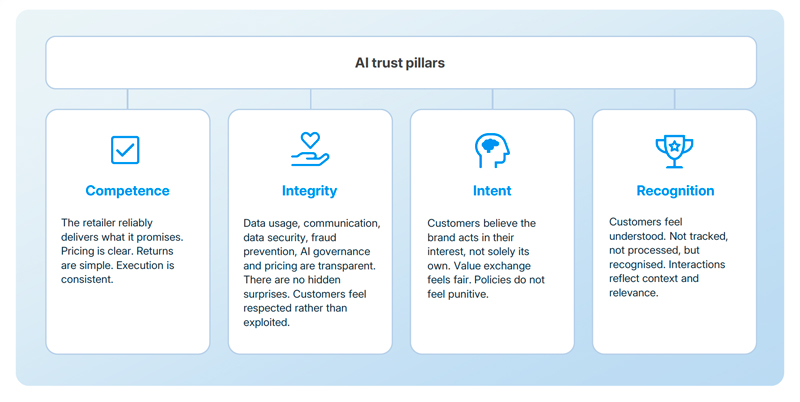
The research identifies four pillars underpinning enduring AI trust: competence, integrity, intent and recognition. Together, these shape whether AI-enabled experiences reinforce confidence or create friction within the customer journey.
Fig. 5 – The pillars of enduring AI trust
Source: Retail Economics, Firstsource
Customers expect retailers to reliably deliver what they promise, communicate transparently and recognise context within interactions. As journeys become more automated, maintaining emotional reassurance and visible accountability becomes increasingly important for sustaining long-term loyalty.
AI amplifies operational weaknesses
Agentic commerce introduces a powerful amplification effect. The same systems that improve convenience and reduce friction can also intensify customer frustration when operational failures occur. Weak fulfilment, inconsistent delivery or unclear policies become more exposed as AI accelerates the customer journey.
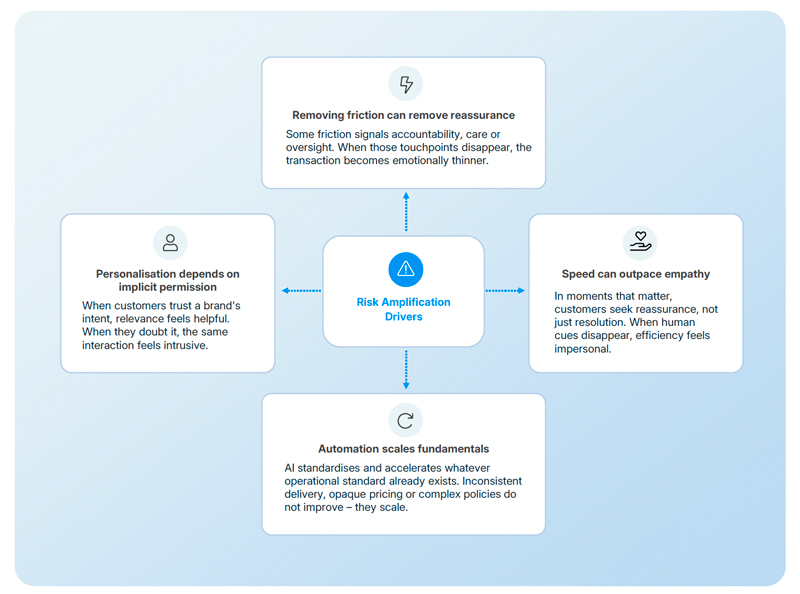
The report identifies four drivers behind this amplification effect: removing friction can remove reassurance, speed can outpace empathy, automation scales existing operational realities, and personalisation depends on implicit permission from the customer.
Fig. 6 – Four drivers amplifying loyalty risk in AI-enabled retail journeys
Source: Retail Economics, Firstsource
This means the operating model behind the interface increasingly determines whether AI creates or destroys value. Strong execution reinforces trust and conversion. Weak execution accelerates switching and erodes loyalty at greater speed and scale.
The rise of agentic retail ecosystems
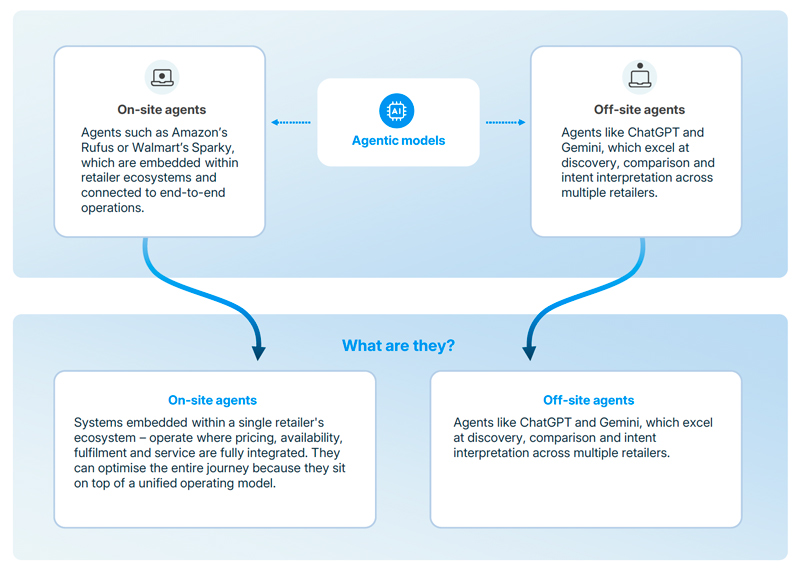
The report highlights two emerging models of agentic commerce. On-site agents operate within retailer ecosystems where pricing, availability, fulfilment and service are integrated end-to-end. Off-site agents, such as ChatGPT and Gemini, increasingly shape discovery, comparison and intent interpretation across multiple retailers.
This shift redistributes influence across the customer journey. Retailers no longer control every stage of discovery, placing greater importance on operational consistency and data quality across every customer touchpoint.
Fig. 7 – Two models of agentic commerce
Source: Retail Economics, Firstsource
Retailers with connected operating models and integrated ecosystems are better positioned to benefit from AI-enabled commerce because they can optimise discovery, pricing, fulfilment and service together rather than in isolation.
AI is reshaping how consumers discover, evaluate and choose. The retailers that succeed will not simply deploy new technology. They will strengthen the operating models behind it, ensuring reliability, transparency and service quality remain consistent across increasingly automated customer journeys.