The B2B delivery blind spot: The overlooked decisions costing your business
DOWNLOAD FREE REPORT
7 minute read
Take control of the delivery decisions costing your business
Research with 100 UK B2B decision-makers reveals how carrier dependency embeds cost, weakens resilience and limits delivery control
B2B parcel delivery has quietly become one of the largest unmanaged costs in the operating model. While demand forecasting, inventory and warehousing have been modernised and optimised, final-mile delivery has arguably been left behind – shaped by legacy contracts, default carrier choices and a reliance on relationships that were rarely designed around today’s operational need.
The B2B Delivery Blind Spot, produced by Retail Economics in partnership with GFS, examines how outbound delivery is structured, managed and paid for. Most businesses use more than one carrier, but few are genuinely in control. Volume remains heavily concentrated with a primary provider, driving higher costs, weaker resilience and routine overuse of premium services. The report assesses four levers of delivery control – carrier flexibility, commercial control, operational resilience and cost discipline – and quantifies the commercial opportunity.

What you can learn
• Audit whether your delivery setup provides usable carrier choice or leaves volume concentrated with a primary provider.
• Benchmark your business against delivery leaders across the four levers of delivery control.
• Identify how default service choices, limited cost visibility and manual intervention embed avoidable costs.
• Build a coordinated delivery strategy around order requirements, customer needs and commercial value.
Key report insights
• Nine in ten businesses use more than one carrier, yet around two-thirds of outbound parcel volume still flows through a single provider.
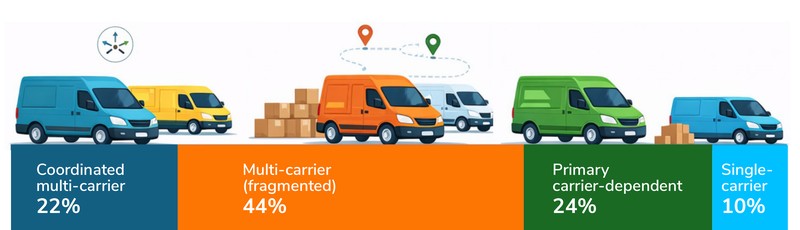
• Only 22% operate coordinated multi-carrier models, while 44% manage multiple carriers through fragmented relationships.
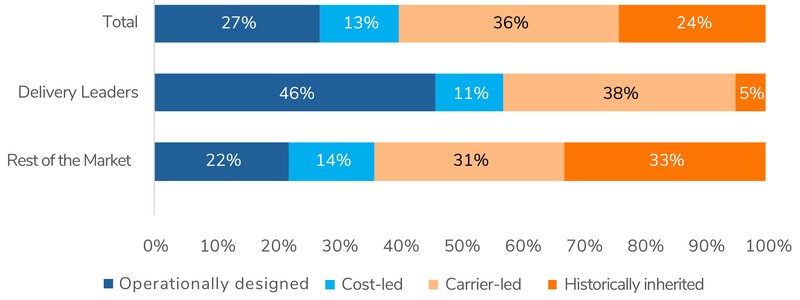
• 60% describe their delivery strategy as carrier-led or historically inherited, rather than operationally designed or cost-led.
• 44% frequently use premium delivery for orders that are not time-critical, rising to 81% when those doing so sometimes are included.
• 55% report that carrier-related issues often or almost always require operational intervention, drawing staff into resolving delivery problems.
• Delivery leaders operate parcel delivery cost structures around 17% lower than the wider market, according to the report’s benchmark analysis.
• Modelled annual savings of approximately £200k–£250k are available to a typical mid-sized business moving from primary carrier dependency to a coordinated multi-carrier approach, depending on delivery profile and operating model.

1. The blind spot: Multi-carrier usage without control
Delivery is one of the most business-critical parts of the B2B operating model. It is also one of the least controlled. Across manufacturing, wholesale and distribution, businesses have modernised how they forecast demand, manage inventory and run warehouses. Final-mile delivery often lacks the same visibility and governance, shaped instead by legacy contracts and an overreliance on a primary carrier.
Figure 1 shows how sharply carrier management varies. Almost half of businesses (44%) operate fragmented multi-carrier models, with selection managed across separate relationships rather than through a single point of control. Only 22% operate a coordinated model, where delivery is brought together into a centrally managed framework that supports consistent execution. A further 34% remain heavily reliant on a primary carrier, either defaulting most volume to one provider or using a single carrier altogether.
Figure 1 – Multi-carrier usage is the norm, but how it’s managed varies significantly
Source: Retail Economics, GFS
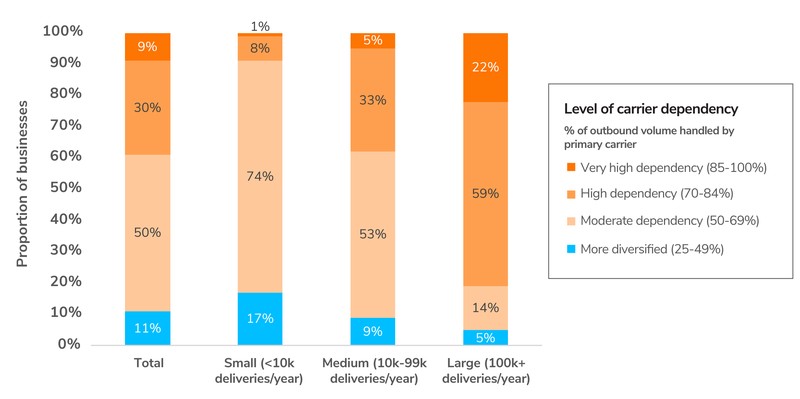
Volume tells a clearer story in Figure 2. On average, two-thirds of outbound parcel volume is handled by a single carrier, and around 90% of businesses send more than half of their shipments through one provider. Concentration also rises with scale: larger businesses show the highest dependency, with more than one in five sending over 85% of delivery volume through a single provider. At higher volumes, embedded relationships, operational standardisation and contractual structures make diversification harder to achieve.
Figure 2 – Delivery volume remains heavily concentrated with a primary carrier: Around two-thirds of outbound parcel volume handled by a single carrier
Source: Retail Economics, GFS
Implications for your business: Carrier choice on paper is not control in practice. Audit where parcel volume actually flows and whether alternative carriers can be used when required. When volume is concentrated with one provider, switching is slower, service is harder to align to the needs of the order, and dependency deepens.
2. The four levers of control: Turn carrier choice into operational flexibility
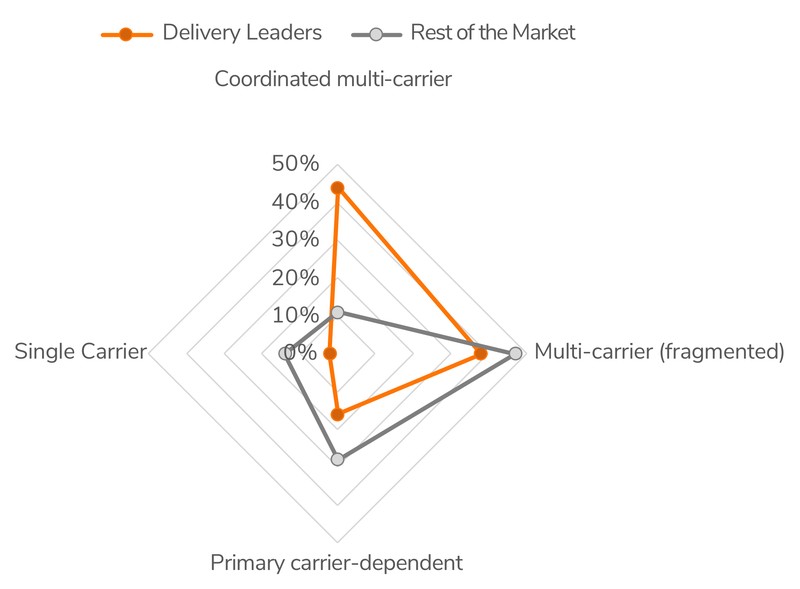
Differences in B2B delivery performance reflect how delivery is structured, managed and executed. The report assesses carrier flexibility, commercial control, operational resilience and cost discipline, classifying the top-performing third of businesses as delivery leaders. Figure 5 shows that these leaders are more likely to operate coordinated multi-carrier models. Carrier flexibility sits at the heart of delivery performance because it determines how much control a business has over cost, service and resilience.
Figure 5 – Delivery leaders are more likely to operate coordinated multi-carrier models
Source: Retail Economics, GFS
The lack of control shows up in how delivery strategies are defined. Across the market, delivery is often shaped externally rather than designed around operational need: 60% of businesses describe their approach as either carrier-led or historically inherited. Figure 6 shows that delivery leaders are far more likely to operate models designed around business and customer requirements: 46% describe their strategy as operationally designed, compared with 22% of the rest of the market.
Figure 6 – B2B delivery strategy is rarely designed around operational need
Source: Retail Economics, GFS
If carrier flexibility determines what is possible, commercial control determines whether it is being used effectively. Without clear visibility of delivery cost and performance, even the most flexible models struggle to deliver consistent value. Fewer than half of businesses review or re-tender carrier rates at least annually. Delivery leaders have materially stronger visibility across the cost dimensions that matter most commercially, particularly by customer and service urgency, enabling cost to be managed continuously rather than periodically.
Operational resilience separates delivery models that absorb disruption from those that amplify it. Over a third of businesses (35%) report that carrier-related issues often require operational involvement, with a further 20% saying this happens almost always. Once intervention is required, the impact compounds quickly: 48% report manual re-booking, 45% customer compensation and 41% reduced repeat business or customer churn when deliveries fail or are delayed.
Implications for your business: Design carrier selection around operational need and make delivery cost visible by customer, service level and urgency. Keep alternative carrier options ready to use, so disruption is contained within the delivery function rather than escalating into customer impact or commercial loss.
3. Delivery on your terms: Match service to need and unlock savings
Cost discipline is where the performance gap between delivery models becomes most visible. Stronger businesses do not simply spend less. They are more precise in how delivery services are used, aligning speed and cost to the actual needs of the order. Across the market, premium delivery services such as next-day, timed or expedited options are often used by default rather than by design. Over four in ten businesses (44%) say premium services are frequently applied even when the order is not time-critical.
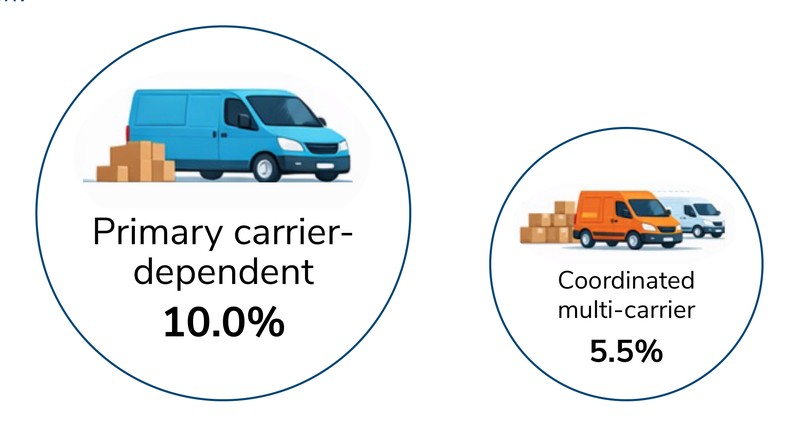
The inefficiency is already recognised within the model. As Figure 13 shows, businesses operating primary carrier-dependent models estimate that around 10% of delivery spend could be removed through better carrier management and service optimisation, compared with just 5.5% among those already using coordinated multi-carrier models. Constrained delivery structures carry materially more embedded inefficiency, translating into higher operational costs and lower resilience.
Figure 13 – Primary carrier–dependent models have greater unrealised cost savings
Source: Retail Economics, GFS
Cost discipline is not driven by negotiation alone. It comes from making better decisions at the point of execution, ensuring delivery service levels reflect genuine operational need rather than default behaviour. Taken together, improvements across carrier flexibility, cost visibility, operational resilience and service-level optimisation compound into a material cost advantage. Businesses demonstrating strong control across all four areas operate parcel delivery cost structures around 17% lower than the wider market.
Separately from the self-reported opportunities in Figure 13, benchmark modelling indicates that moving from a primary carrier-dependent model to a coordinated multi-carrier approach can reduce parcel delivery costs by around 12%. The report estimates approximately £200k–£250k in annual savings for a typical mid-sized business with £50m–£149m revenue, shipping around 500 parcels per day, depending on delivery profile and operating model. These are indicative modelled savings, based on survey evidence and GFS operational data.
Implications for your business: Challenge default premium services, match delivery speed to genuine order requirements and commercial value, and use ongoing cost visibility to identify avoidable spend. Assess the opportunity against your own delivery profile, then coordinate carrier choice and service levels at the point of execution.
Delivery is no longer a fixed operational cost. It is a controllable lever of performance for businesses able to structure, manage and execute delivery more effectively. The report sets out how to reduce primary carrier dependency, strengthen commercial governance and prevent disruption from becoming a wider business cost.