Report Summary
Period covered 05 July – 01 August 2026
3 minute read
Note: This report summary is one or two months behind the current month as standard reporting practice. The content is indicative only and incomplete with certain data undisclosed. Become a member to access this data or take out a free 30 day membership trial now.
Furniture & Flooring – Retail Economics Index
Furniture and flooring sales increased by xx% year-on-year in July, below the xx growth recorded in the same month last year.
The category has struggled to share in the stronger summer performance seen elsewhere in retail. Three months of exceptional weather created obvious reasons to spend on clothing, beauty, food and outdoor products, whereas furniture and flooring remained tied to larger household decisions that were easier to defer.
Replacement purchases and existing projects continued to generate sales, but there was little evidence of a wider return to big-ticket home spending.
Key trading themes and drivers
Housing activity remains one of the main constraints on the sector. Moving home frequently prompts spending on sofas, beds, dining furniture and flooring, whether through necessity or the desire to furnish a new property.
That source of demand remained weak during July, with annual house price growth slowing to xx% and sales agreed running xx below last year's level. Mortgage approvals recovered slightly to xx in June but remained around xx below June 2025, leaving fewer housing transactions to generate the purchases that typically follow a move.
The financial commitment required for furniture and flooring also separates the category from much of the spending that performed well during the summer. Consumers continued to find room for smaller purchases and products associated with holidays, social occasions and the hot weather, but a new sofa, bed or flooring project requires considerably more money and usually more planning. When household finances are tight, extending the life of an existing item remains an easy way to avoid a sizeable outlay.
July's exceptional weather offered little help. The UK experienced its second warmest July on record, following unusually warm conditions in May and June, directing attention towards gardens, travel and time spent outside the home.
For furniture and flooring, the extended summer provided fewer natural prompts for consumers to begin larger indoor projects, particularly when those purchases could wait until later in the year.
Consumer behaviour and store trends
Furniture and flooring purchases continue to involve lengthy consideration periods, with consumers able to research products, compare prices and delay the final decision for weeks or months. This makes the category particularly sensitive to changes in household finances because postponement carries relatively little immediate cost when items remains usable.
July's footfall patterns offered some support to large-format destinations, with retail parks recording xx year-on-year growth in visits. Easier car access remains particularly relevant for furniture retailers, yet stronger traffic did not translate into a comparable improvement in sector sales.
Outlook
Furniture and flooring enters the latter part of the year without the temporary boosts that supported several other retail categories through the summer.
July's xx growth is consistent with a category still waiting for household finances and housing activity to provide a stronger reason to commit.
Mortgage approvals have begun to recover from their recent lows, but activity remains well below last year's level and higher mortgage rates continue to affect affordability.
A sustained increase in transactions would bring more households into the furnishing and refurbishment cycle, whereas another period of weak activity would leave the sector dependent largely on replacement demand and projects already planned.
The exceptionally long summer has kept consumers focused outside the home for much of the past three months, and cooler weather typically brings attention back towards interiors.
The seasonal change can provide more opportunities for furniture and flooring than the summer offered, but households still need to feel comfortable committing the money.
With energy bills higher, borrowing expensive and the housing market subdued, autumn may bring more interest in the home without immediately producing a comparable increase in big-ticket spending.
Take out a FREE 30 day membership trial to read the full report.
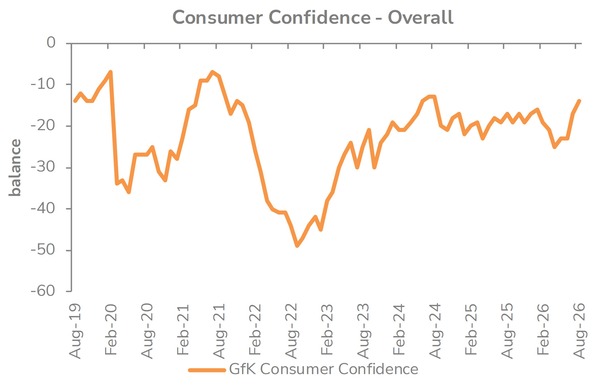
Consumer confidence improved further in August
 Source: GFK