ONS Labour Market October 2026
Payrolls remain below last year’s levels
- Payrolled employees fell by 111,000 (0.4%) between August 2025 and August 2026.
- Compared with the previous month, payroll numbers remained largely unchanged, increasing by 1,000 (0.0%).
- Across June to August 2026, payrolled employees declined by 92,000 (0.3%) YoY and by 37,000 (0.1%) on the quarter.
- The early estimate for September 2026 suggests a decrease of 66,000 (0.2%) on the year and an increase of 13,000 (0.0%) on the month, leaving total payrolled employees at 30.3 million (provisional and subject to revision)
Employment rises, unemployment edges down
- The UK employment rate for people aged 16-64 was 75.3% in June to August 2026, up 0.2 percentage points on both the year and the quarter.
- The unemployment rate stood at 4.7%, down 0.1 percentage points on both the year and the quarter.
Inactivity eases as claimant numbers rise
- The economic inactivity rate for people aged 16-64 stood at 20.9% in June to August 2026, down 0.2 percentage points on the year and 0.1 percentage points on the quarter.
- The Claimant Count increased on both the month and the year to 1.701 million in September 2026 (provisional).
Regular pay growth stable as total pay growth eases
- Regular earnings excluding bonuses increased by 3.7% YoY in June to August 2026, with growth remaining relatively stable over the past six three-month periods.
- Total earnings including bonuses rose by 3.7%, down from 3.9% in the previous three-month period, marking the lowest growth rate since 2020.
- Public sector regular pay growth was 6.3%, compared with 3.0% in the private sector. Public sector growth continued to be affected by variations in the timing of pay awards.
- In real terms:
- CPIH-adjusted earnings rose by 0.6% for regular pay and 0.7% for total pay.
- CPI-adjusted earnings increased by 0.8% for regular pay and 0.9% for total pay.
Vacancies record largest fall since early 2026
- Job vacancies fell by 21,000 (2.9%) on the quarter to 691,000 in July to September 2026, the largest quarterly decline since January to March 2026.
- Vacancies decreased by 37,000 (5.1%) on the year and by 28,000 since January to March 2026.
- Excluding the pandemic period, vacancies were at their lowest level since 2014, with higher labour costs weighing on recruitment among smaller firms.
The estimated number of vacancies has seen a quarterly decrease of 21,000 to 691,000
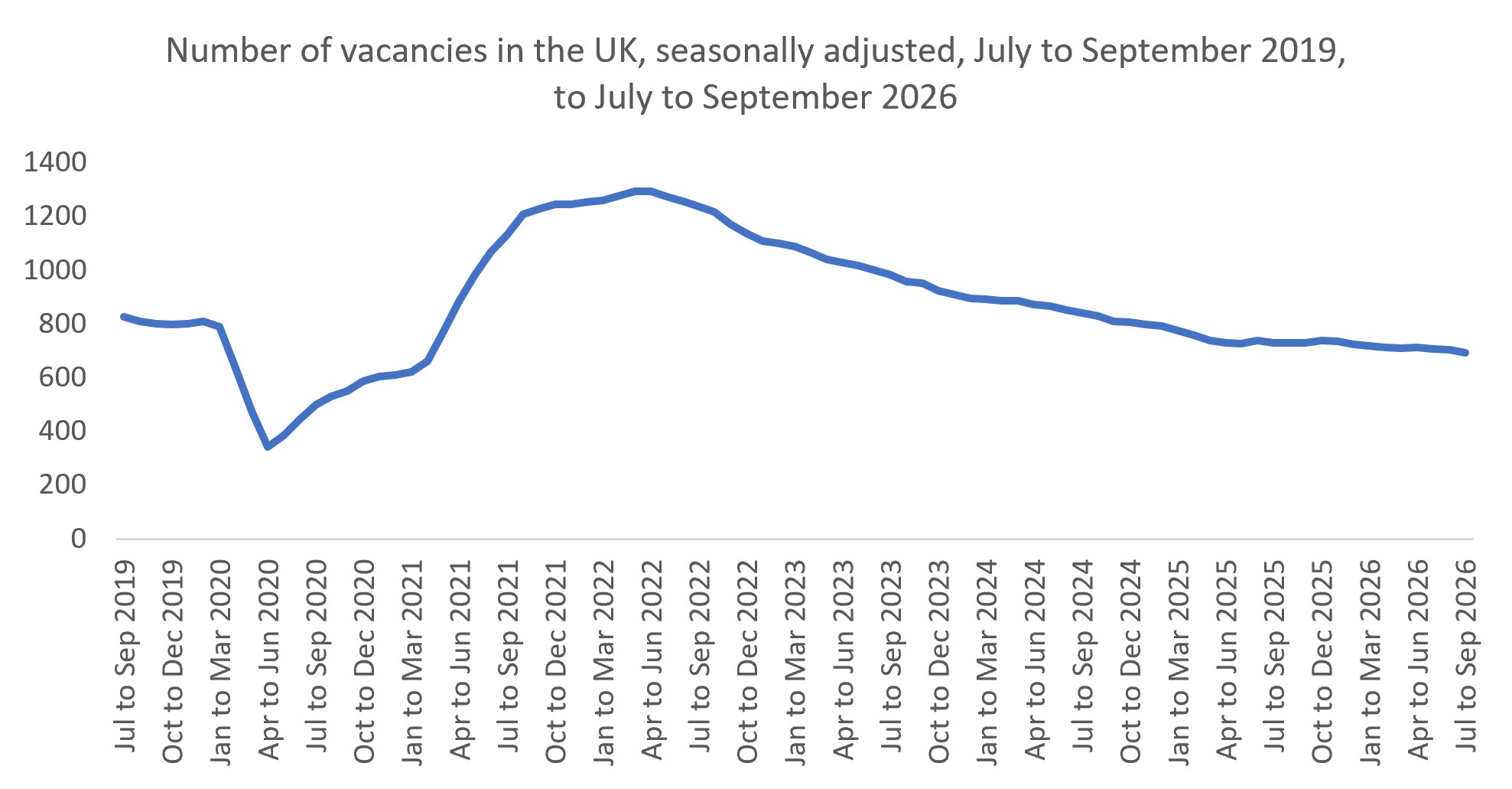
Source: ONS
Back to Retail Economic News