ONS Labour Market June 2026
Payrolls continue to weaken
- Payrolled employees fell by 138,000 (0.5%) between April 2025 and April 2026.
- Compared with the previous month, payroll numbers decreased by 53,000 (0.2%).
- Across February to April 2026, payrolled employees declined by 103,000 (0.3%) year-on-year and by 31,000 (0.1%) on the quarter.
- The early estimate for May 2026 suggests a decrease of 119,000 (0.4%) on the year, while remaining broadly flat on the month (+2,000), leaving total payrolled employees at 30.3 million (provisional and subject to revision).
Employment remains stable as unemployment eases
- The UK employment rate for people aged 16-64 was 75.0% in February to April 2026, largely unchanged on both the year and the previous quarter.
- The unemployment rate stood at 4.9%, up 0.3 percentage points on the year but down 0.3 percentage points on the quarter.
- Total employment reached 34.4 million, the highest level on record.
Inactivity edges up as claimant numbers rise
- The economic inactivity rate (aged 16-64) stood at 21.0%, up 0.3 percentage points on the quarter but down 0.3 percentage points on the year.
- The Claimant Count increased on both the month and the year in May 2026, reaching 1.712 million (provisional).
Vacancies fall to lowest level since 2021
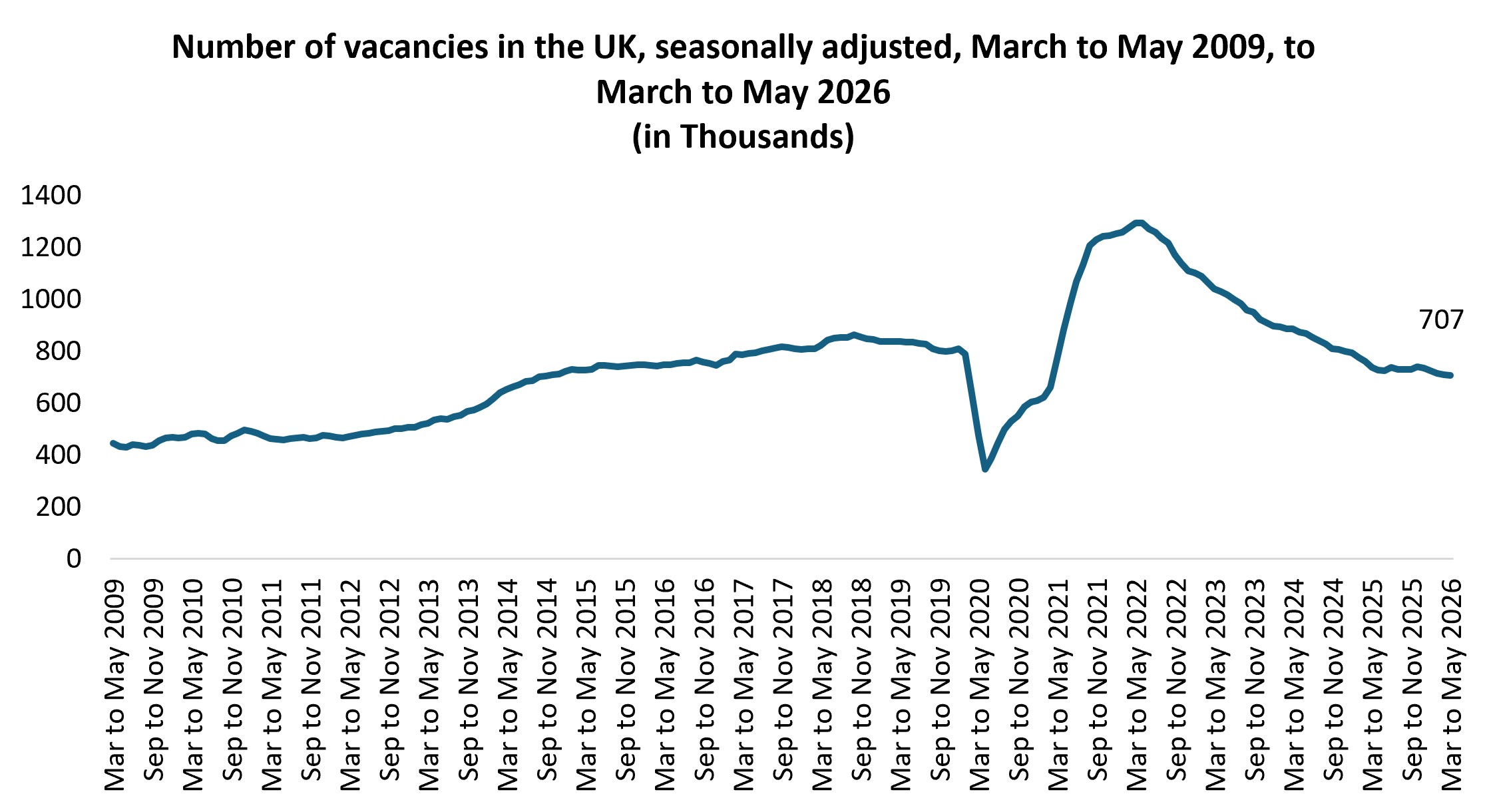
- Job vacancies continued to decline, with early estimates for March to May 2026 showing a fall of 19,000 (2.6%) on the quarter to 707,000.
- This represents the lowest vacancies level since February to April 2021, as employer hiring demand eased.
Workforce jobs rise despite softer payroll trends
- The number of workforce jobs increased by 256,000 (0.7%) on the quarter to 36.8 million in March 2026.
- Growth was driven by a 177,000 (4.4%) increase in self-employment jobs and an 81,000 (0.3%) rise in employee jobs.
- Compared with a year earlier, workforce jobs were down 98,000 (0.3%).
Pay growth continues to moderate
- Regular earnings (excluding bonuses) increased by 3.4% year-on-year, while total earnings (including bonuses) rose by 4.4% in February to April 2026.
- Public sector regular pay growth was 5.1%, compared with 2.9% in the private sector.
- In real terms:
- CPIH-adjusted earnings rose by 0.1% for regular pay and 1.2% for total pay.
- CPI-adjusted earnings increased by 0.3% for regular pay and 1.3% for total pay.
Public sector employment continues to expand
- Public sector employment reached 6.19 million in March 2026.
- This was broadly unchanged on the quarter but 37,000 (0.6%) higher than a year earlier.
Labour disputes increase
- An estimated 120,000 working days were lost to labour disputes in April 2026, with doctors’ strikes accounting for most of the disruption.
The estimated number of vacancies has seen a quarterly decrease of 19,000, following broadly flat estimates between March to May 2025 and December 2025 to February 2026
Source: ONS
Back to Retail Economic News