ONS Labour Market February 2026
Payrolled Employees
- Payrolled employees fell by 121,000 (0.4%) between December 2024 and December 2025.
- They decreased by 6,000 (0.0%) between November and December 2025.
- Over October to December 2025, payrolled employees fell by 130,000 (0.4%) year-on-year and by 46,000 (0.2%) quarter-on-quarter.
- The early estimate for January 2026 suggests a further fall of 11,000 on the month and 134,000 (0.4%) on the year, taking the total number of payrolled employees to 30.3 million (provisional and subject to revision).
Employment and Unemployment
- The employment rate (aged 16-64) was 75.0% in October-December 2025, down on the quarter and unchanged on the year.
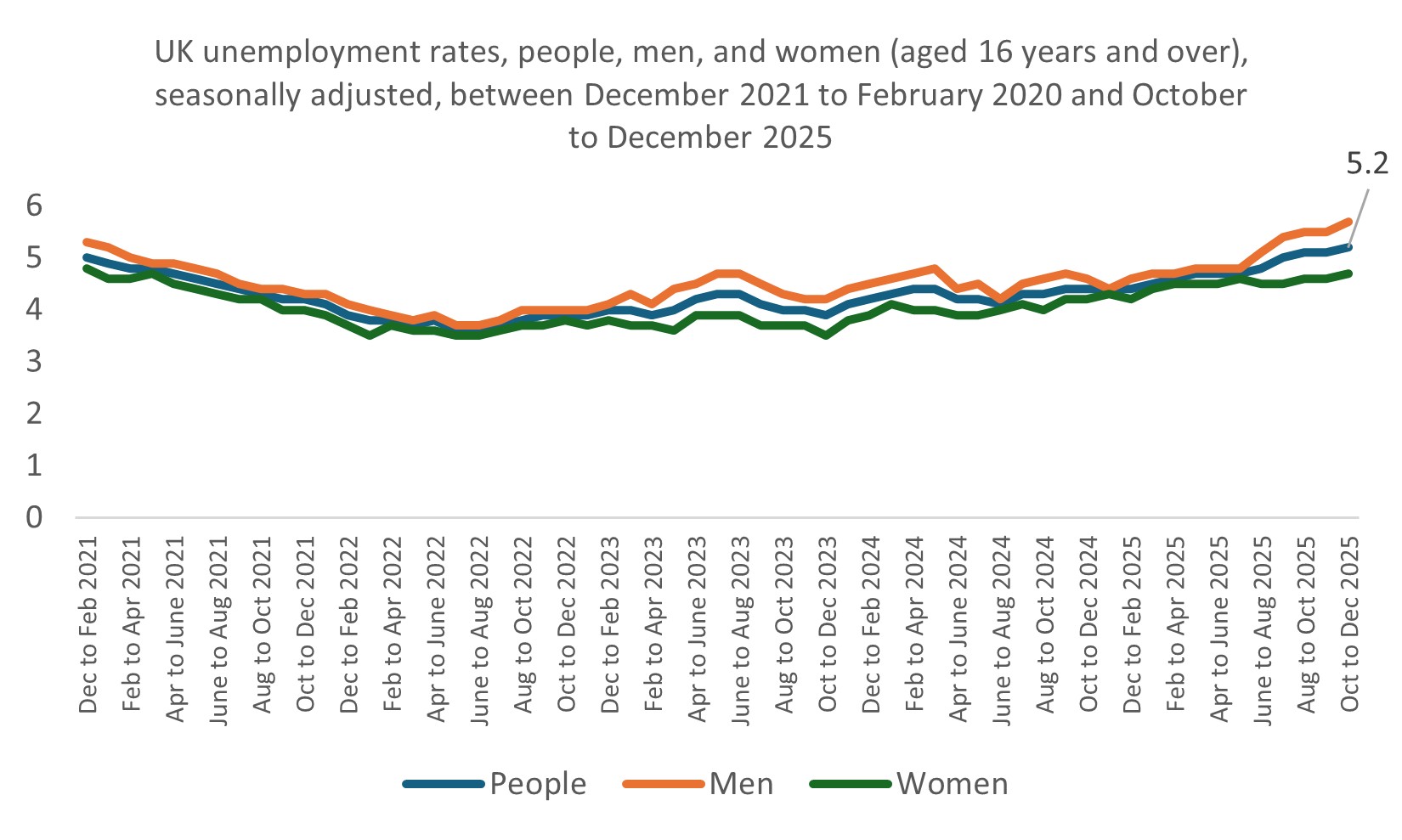
- The unemployment rate (aged 16+) rose to 5.2%, increasing on both the quarter and the year.
Economic Inactivity and Claimants
- The economic inactivity rate (aged 16–64) stood at 20.8%, down on the quarter and lower than a year earlier.
- The Claimant Count increased on the month in January 2026 but fell on the year, reaching 1.691 million (provisional).
Vacancies
- Early estimates for November 2025 to January 2026 suggest vacancies edged up slightly by 2,000 (0.3%) on the quarter to 726,000, indicating broadly flat labour demand after a period of easing.
Earnings Growth
- Regular earnings (excluding bonuses) increased by 4.2% year-on-year, while total earnings (including bonuses) also rose by 4.2% in October-December 2025.
- Public sector regular pay grew by 7.2%, compared with 3.4% in the private sector, reflecting the timing of 2025 public sector pay settlements.
- In real terms:
- CPIH-adjusted earnings rose by 0.5% for both regular pay and total pay.
- CPI-adjusted earnings increased by 0.8% for regular pay and 0.7% for total pay.
- Average weekly earnings (AWE) were estimated at £735 for total earnings and £691 for regular earnings in December 2025.
Labour Disputes
- An estimated 118,000 working days were lost to labour disputes in December 2025, with over two-thirds attributable to strike action in the health and social work sector.
The unemployment rate increased in the latest quarter
Source: ONS
Back to Retail Economic News