UK Electricals Sector Report summary
July 2026
Period covered: Period covered: 31 May – 04 July 2026
3 minute read
Note: This report summary is one or two months behind the current month as standard reporting practice. The content is indicative only and incomplete with certain data undisclosed. Become a member to access this data or take out a free 30 day membership trial now.
Electricals sales
Electricals sales increased by 4.0% year-on-year in June, more than double the sector's three-month average growth of 1.9%, making it one of the strongest monthly performances so far this year.
The improvement came at a time when consumers remained selective in their discretionary spending.
June's trading also contrasted with several other big-ticket retail sectors. While furniture and flooring continued to be influenced by housing market conditions, electricals recorded stronger growth, supported by seasonal demand, World Cup, and replacement purchasing.
Key drivers and category performance
Seasonality played an important role in June's performance. Record temperatures created demand for products that improved comfort during prolonged periods of hot weather, while the approach of the summer holiday season supported purchases linked to travel and leisure.
These seasonal drivers provided retailers with opportunities that were largely absent during the opening months of the year.
Replacement purchasing also remained an important feature of the market. Unlike many discretionary retail categories, demand for electrical products is often driven by necessity as much as choice, with consumers replacing ageing or broken appliances.
That characteristic helped support sales during a month when households remained cautious about wider discretionary spending.
Online retail continued to provide an important route to market for electricals. Consumers typically research specifications, compare prices and read reviews before committing to higher-value purchases, making digital channels central to the buying journey.
Underlying environment
The economic backdrop became more supportive during June, although households remained disciplined in the way they allocated discretionary spending. Consumer price inflation eased to 2.6% from 2.8% in May as transport costs and food inflation continued to moderate, reducing pressure on everyday household expenditure and leaving consumers with slightly greater financial flexibility.
Interest rates remained elevated, with the Bank of England maintaining Bank Rate at 3.75%, while consumer confidence continued to sit in negative territory and labour market conditions softened further.
These factors continued to weigh on confidence around major household expenditure, particularly purchases that could be postponed without consequence.
Electricals proved relatively resilient within that environment because demand is influenced by more than consumer confidence alone.
Replacement purchases cannot always be deferred, while seasonal products responded directly to June's exceptional weather. The sector therefore benefited from a combination of improving household finances, practical purchasing needs and seasonal demand, allowing sales growth to accelerate well beyond the average recorded over the previous three months.
Outlook
June's performance suggests the electricals market is entering a period in which targeted demand is becoming more important than broad consumer optimism. Retailers are benefiting when products solve an immediate problem, improve everyday living or meet a seasonal requirement.
The sector's performance in June shows that electrical retailing can outperform the wider discretionary market, but success will continue to depend on giving consumers a compelling reason to buy now.
Take out a FREE 30 day membership trial to read the full report.
Real GDP grew by 0.7% in the three months to April 2026, following a growth of 0.6% in the three months to March 2026 and a growth of 0.5% in the three months to February 2026
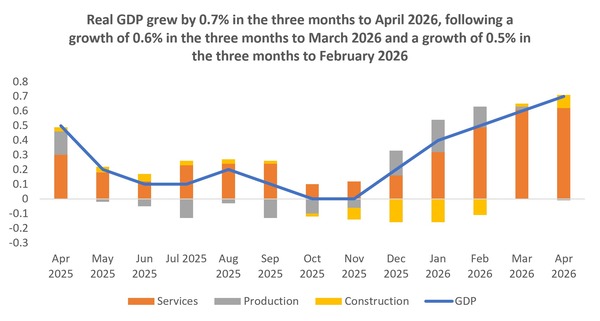 Source: Retail Economics, ONS